Tuesday, 4 March 2014

A Sedge of Cranes...and pasta & beans

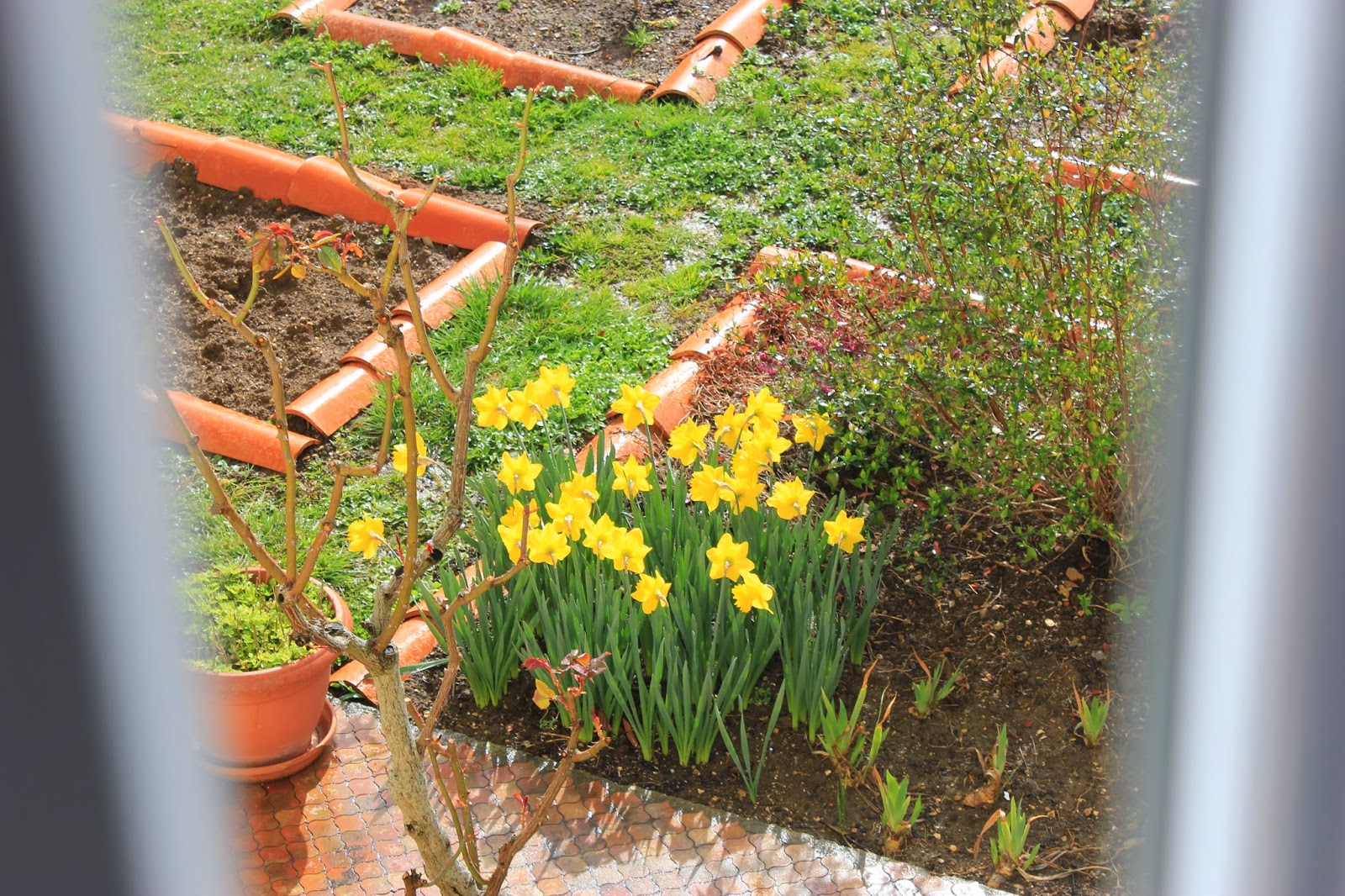
Spring is just beginning. When opening my office shutters in the morning, I see the daffodils' indomitable splash of sunshine, even on a cloudy, wet day which unfortunately are most days because of this never-ending bout of weather which should be more at home in Britain than France. Not that the poor sods across the channel need to be any more sodden then they already are what with the flooding and such happening over there. 


The rose bush in the foreground is leafing out along with irises on the right


They say, there's sunniness to spare, go ahead and bring some of us indoors, and I do, along with their fresh, flowery fragrance.


The daily deluge has engorged the sweet violets with such an abundance of water that they are naturalizing partout, another sign spring is having its fresh way with our garden.


But the most startling and delightful harbinger are the cranes migrating from North Africa for the last several days. Their pronounced honking gives ample warning for me to dash upstairs and get the telephoto lens. 

The group I had spotted before my indoor sprint still was far away so I was confused why they sounded like they were overhead. Monsieur M  popped out of his atelier at the back of his garden and said, can you hear them? Yes, I replied while pointing to the cranes off in the distance. Non, non, said Monsieur M. He pointed directly overhead to many cranes seemingly hovering in one place.


Then my guys flew in.


Keeping a tight formation, they joined the others.


Birds are an integral part of my gardening life, and I do my best to help them out. Leaving berries on bushes for them is one way. Ivy is a boon in that regard, because they form and hold their fruit way after most other plants have gone barren.

Ceci n'est pas a blueberry plant

Another supportive measure for avian life is keeping a wild area. Some starlings, probably close to a hundred, are wont to hide in the mountain of brambles in the back of our garden, twittering away unseen.

Some of the grape vines in the foreground are not covered with nets so the birds can have a tasty 'drink'

Being busy preparing for spring planting and sowing indoors--the tomatoes are now in the incubator--means I am still focused on easy, fast, hot meals and pasta and beans is such a dish. While some linguine is on the boil, saute a minced garlic clove or two or three in a tablespoon or so of olive oil for a minute or two. Add and simmer together for about ten minutes: a frozen cube of homemade chicken/veggie stock (store-bought can be subbed), a tablespoon or so of tomato paste, heaps of basil (there's still ample frozen basil from last summer's harvest), a tablespoon or so of reserved pasta water, and some rinsed, canned white beans. Drain the cooked pasta and mix with the sauce. Add salt and freshly ground black pepper to taste. Really. Good. Stuff.


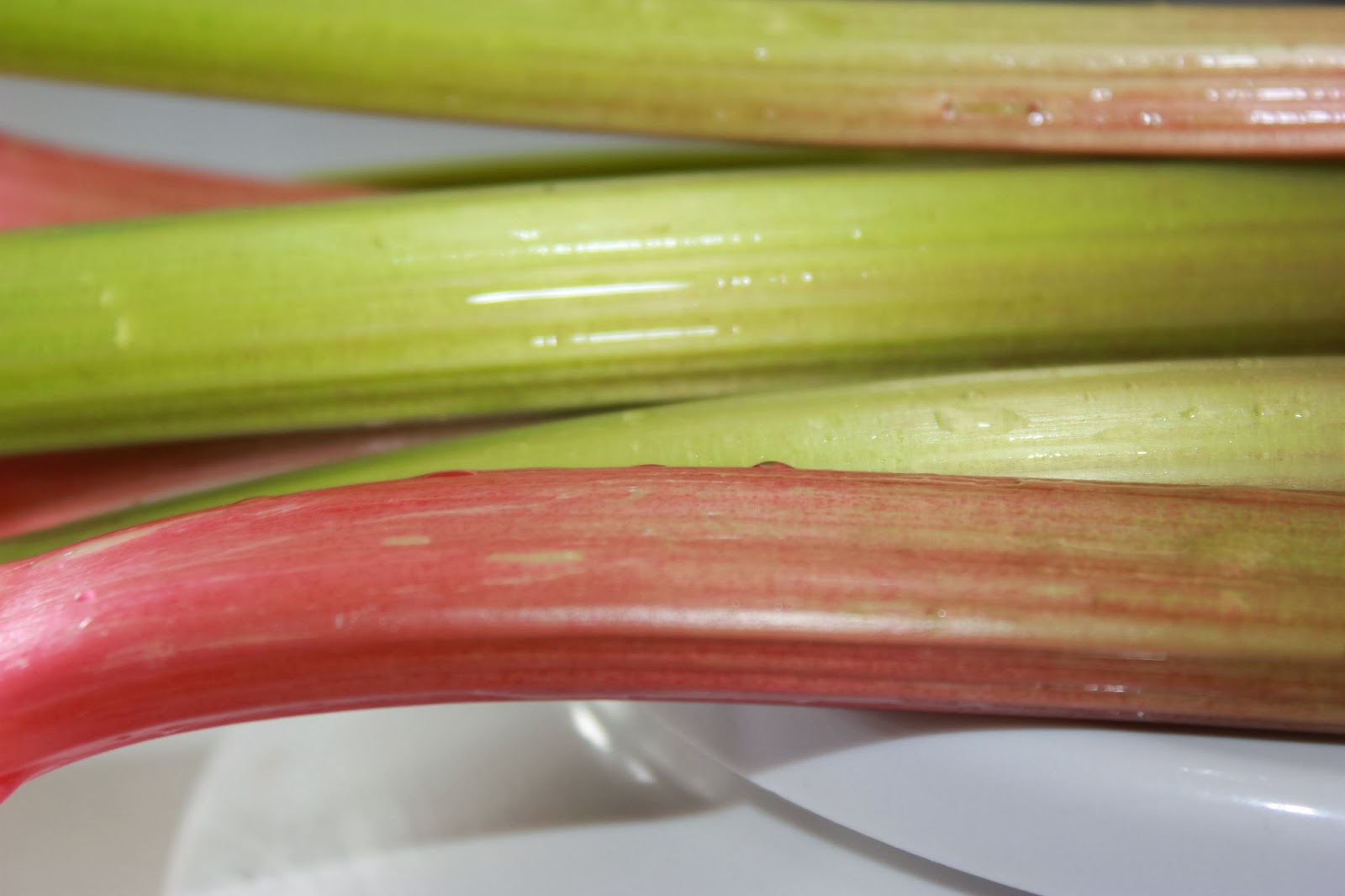
The first harvest of rhubarb was happily done. The title of this post was supposed to be Rhubarb Souffle, but the silly thing decided suddenly to inflate with a vengeance and then almost just as abruptly deflate with a determined malfeasance. No rhubarb souffle for us! At least, not this week as I will try again.

À la prochaine!
Wednesday, 26 February 2014

Spinach Parmesan Burek

Certain food items are hard to come by outside Paris and prepared sheets of filo pastry are one of them. Though it can be made at home, I have neither a dowel rolling pin or a pasta maker to get the dough rolled out thin enough. However, I found out that in the Balkans the dough is stretched by hand instead of rolling it out. In order to accomplish this feat, it needs to be soaked in oil and a large enough surface is required for its expansion, not to mention the necessity of well clipped fingernails.

Spinach burek and hot, sweet mint tea

My focusing on sowing indoors and getting the early potatoes and peas into the ground--though the weather has different ideas like turning our potager into a mud flat--is balanced with my identifying what remains in our freezer from last season's harvest. A solitary bag of spinach skulking way in the back behind homemade soups and pizzas said hello, use me please! So I did as it became the filling for my first burek.


Thrilled as I was with not having to roll out super-thin pastry sheets, I was not at all excited about using oceans of oil. Instead, I subbed clarified butter which worked out very well. Cut two-hundred-fifty grams/nine dry ounces of unsalted butter into small cubes and melt over a low flame. After about five minutes, the butter will splutter and white foam will form. After another five minutes, it will go quiet and the foam will stop rising to the surface.


Remove pot from heat and skim off as much of the foam as you can.


Pour the clear, buttery-yellow liquid into a jar, being careful to let any sediment remain on the bottom of the pot.


INGREDIENTS
Makes a 12 inch/30 cm diameter burek, that is, 4 large or 6 smaller servings

Flour, white, plain, 250 grams/16 fluid ounces
Salt, 1/2 tsp
Water, 150 ml/5 fluid ounces
Clarified butter (see above for recipe)
Spinach, sauteed in olive oil with a bit of garlic, well drained, 200 grams/10 fluid ounces
Egg, 1 (I used medium, but large would be OK also)
Cream cheese, 4 T
Parmesan, freshly grated, 2 T
Nutmeg, freshly grated, 1/8 rounded tsp
Paprika for dusting

Mix salt and flour together in a large bowl. Add the water, while stirring.


Tip contents of the mixing bowl onto a floured work surface. Knead for about ten minutes or until very smooth and elastic. Test by pulling on one end--it should stretch out easily for several inches.


Weigh out two equal balls of dough. Flatten them out to about an inch/two and a half centimeters thick. Spoon a little of the clarified butter into the bottom of a bowl. It will now look cloudy and thicker than when first made. Put one ball in the bowl, spoon some more clarified butter on it, top with the second ball, and pour enough liquid butter until the balls are nearly covered. Cover the bowl with another bowl and set aside while the filling is made.


To drain the spinach, I grabbed a bunch that fit in my hand and squeezed the liquid into a small bow. I repeated with the rest and then did yet another round of squeezing.

Excess liquid from the spinach is in smaller bowl.

Stir together the spinach, cream cheese, Parmesan, beaten egg, and nutmeg. Salt to taste. Set the mixture aside while stretching out the dough.


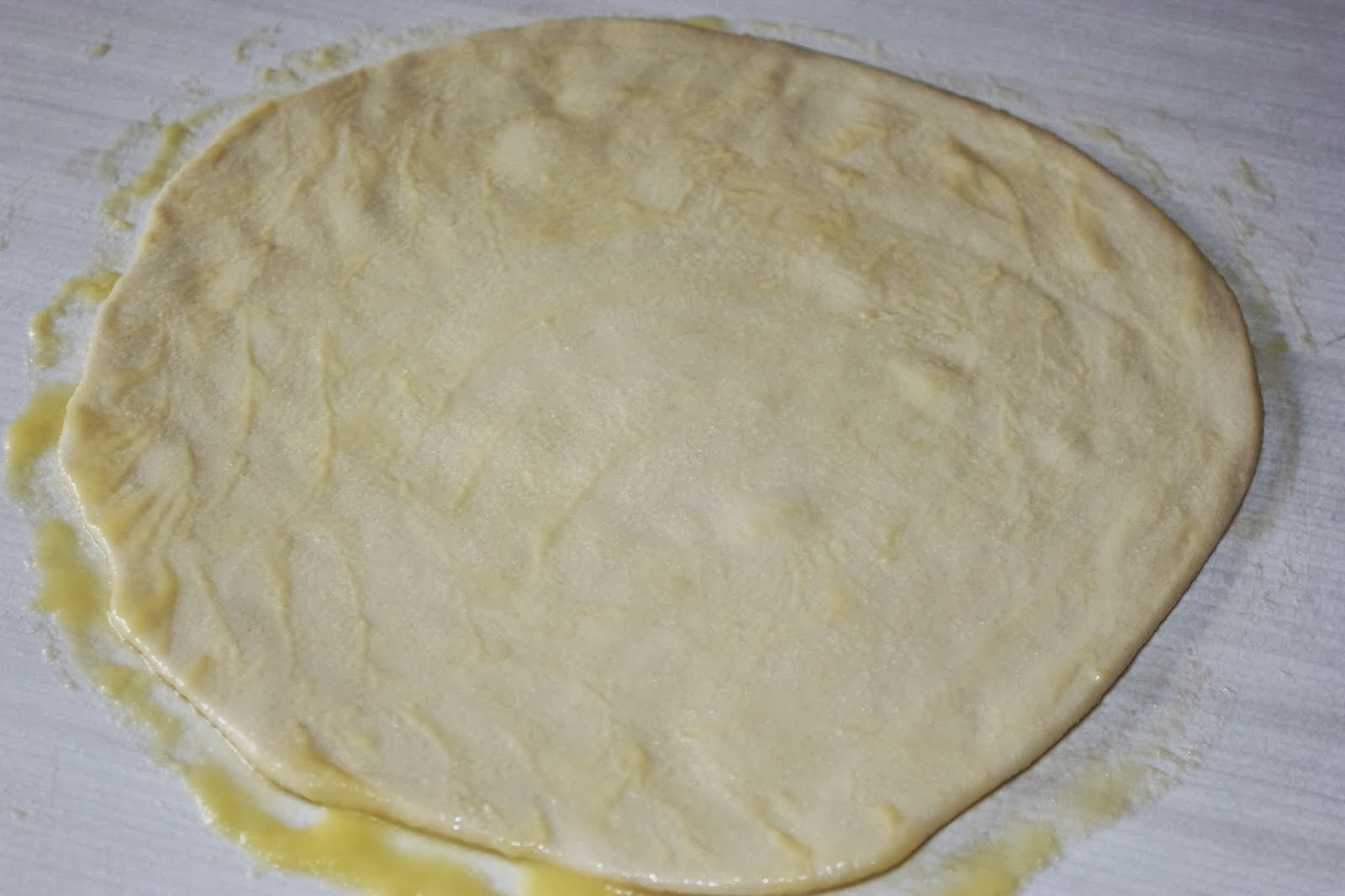
Preheat oven to 200 degrees C/390 degrees F. Remove any rings and make sure your nails are clipped. Place one of the balls on a marbled or laminated surface. Most likely there will be enough lubrication coming from the soaked-in-clarified-butter dough that no additional greasing will be needed. Press from the center towards the edge with your finger tips--the dough circle will easily and quickly spread out as on ball bearings. Be careful not to thin out the center too much. The circle will be about thirty centimeters/twelve inches in diameter.


Working with the dough is like gently flapping out billowing silk sheets. A few punctures here and there won't matter, but you don't want it to be a tattered mess either.


When the dough is about two feet/sixty centimeters in diameter, bring the edges towards the center in about five separate folds. 


It will resemble roughly a pentagon.


Gently shift it away from the main work surface.  Put the second ball on the work surface and stretch/flap it out to about two feet/sixty centimeters in diameter. Place the folded dough onto the pastry sheet.


Spread the filling onto the folded dough. The thicker, outer edges of the second dough sheet could be trimmed. I didn't trim, and the result was fine.


Wrap the spinach-laden pentagon with the underlying sheet of dough via five separate folds. Lifting the dough packet with your fingers (ease/slide them underneath it), transfer it onto a baking sheet. I used a round pizza pan.


Bake around a half hour, until it is a medium golden brown. Dust with paprika.


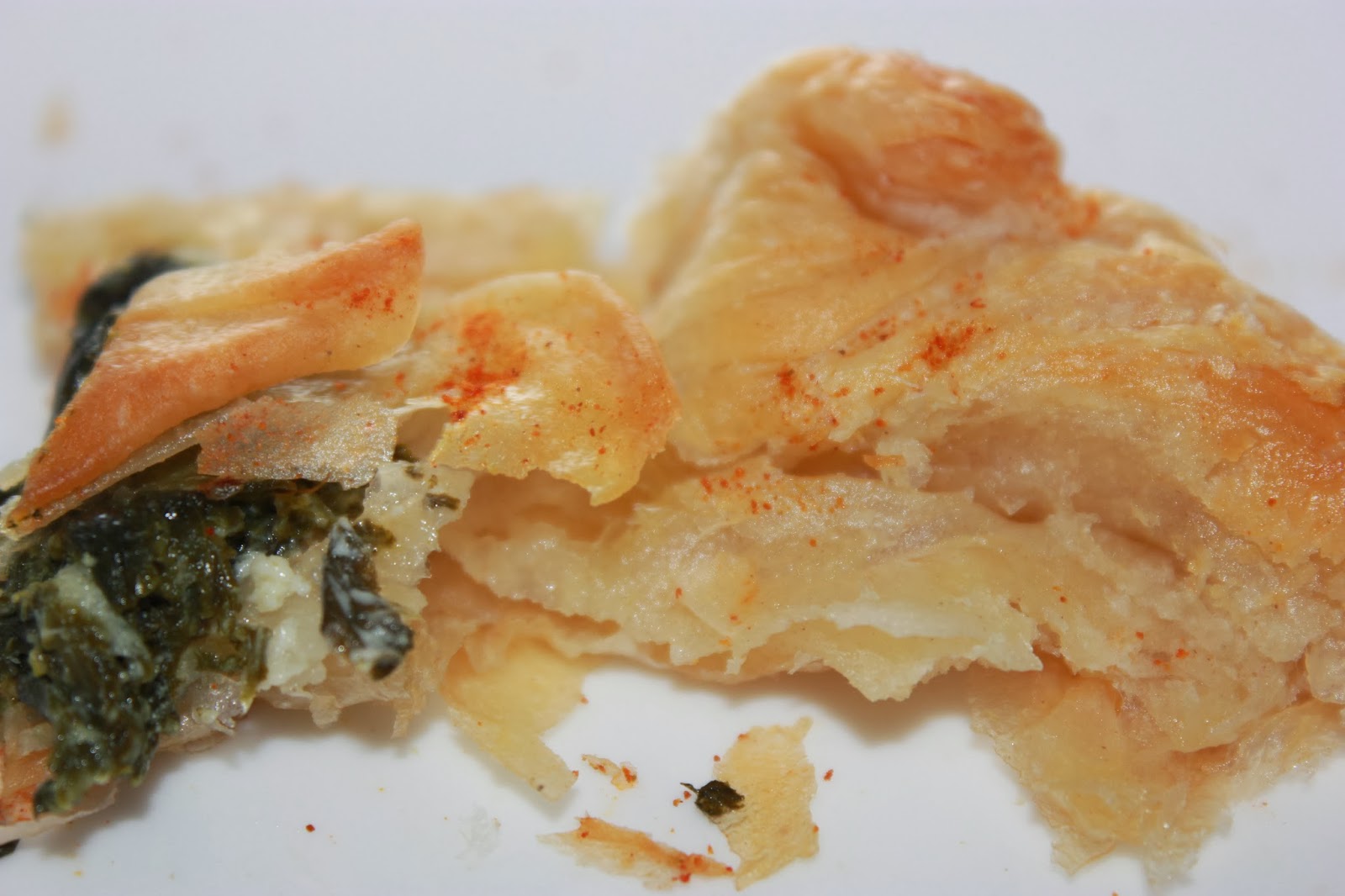
Burek which is served traditionally with cold buttermilk is an amazing melange of flaky, delicate filo, wafer-thin crackers, spring-roll wrapper, and strudel all wrapped in one! It tasted good hot, tepid, or cold. It also froze well.


À la prochaine!

RELATED LINKS

Basic ingredients in pastry depending on technique gives different results

Tuesday, 18 February 2014

Pains de navet au cacao

This savoury turnip flan, enlivened with green peppercorns, brightened with diced carrot, held together with a rich custard, and dusted with unsweetened cocoa (an unexpectedly fantastic addition) is one of the many gorgeous entries found in Mousses et Terrines de Legumes, a scrumptious vegetarian cookbook that I bought shortly after our arriving in France. Book details can be found here.


Though each and every vegetable-based recipe is truly vegetarian, being a French cookbook, suggestions sometimes are made for these creative and delicious concoctions to accompany a meat dish, specifically with game in this recette. Well, I decided to have this as a side with itself, that is, a double helping, because these mounds of goodness bust the wow meter.

INGREDIENTS
makes four 4-inch diameter, 2-inch high individual flans


Turnips, 400 gms, (about four medium turnips)
Carrot, 1 medium
Butter, sweet, 40 gms/just under 3 T (extra for buttering the ramekins)
Peppercorns, green, 1 tsp
Eggs, 3 (recipe did not specify size, I used 3 medium ones)
Cream, heavy, 25 cl/8.3 fluid ounces
Cocoa, unsweetened, 1 T
Salt and sugar if needed

Wash, trim, and peel the turnips and carrot. Cut the carrot lengthwise into several slices. Cut each strip into thinner strips and dice these. Cut the turnips if large into half and slice thinly.


Simmer together the butter, turnips, carrots, and peppercorns till turnips are tender and beautifully translucent, about twenty minutes. Preheat oven to 150 degrees C/302 degrees F.


Let the turnip mixture cool down enough so you can handle the turnip slices. If the turnips are a bit bitter, you can add a little sugar. It was not necessary with mine. Salt to taste.


First butter well the insides of the molds, especially paying attention to their bottoms. Then line them with turnip slices. I used molds 10 cm (4 inches) in diameter by 6.5 cm (2.6 inches) tall. Leave about 2.5 cm (an inch) from the top free. A spiral pattern on the bottom which will become the top of the flan is a nice decorative touch but just make sure that the inside surface is mostly covered.


Crack the eggs into a mixing bowl and whisk till blended. Then beat in the cream.


Add the turnip mixture into the cream and eggs. Put the kettle on the boil.


With a small ladle or serving spoon, fill the ramekins about three-quarters to the top rim which will allow the flans to expand in the oven. First spoon an equivalent amount of solid bits and then evenly distribute the liquid. Lightly tap them on the work surface to eliminate air bubbles. Place in a shallow oven dish and pour an inch of boiling water around the molds.


Either cover with a lid or with foil.


After twenty minutes, remove the covering (contrary to the book's direction because I wanted the top edges to brown a bit) and bake for another twenty, testing by noting that an inserted knife comes out dry.


To serve warm, let them stand for about five to eight minutes. Loosen the flan with a knife or a thin spatula all around its sides. Tip them carefully onto paper towels; if the bottom sticks, remove those turnip slices and replace on the top of the unmolded flan. Let sit for a few minutes for excess moisture to be absorbed.

Though the author presents these in the chaud (hot) sector, I am convinced that not only they taste and look best (the cocoa 'bleeds' unattractively on a hot surface) when served tepid or cold, they are easier to unmold and lend to much more convenient serving as they can be made in advance and brought to room temperature as needed. In any case, dust with the cocoa just before serving. To get a really fine veil of cocoa, put a tiny amount (I used about a 1/2 tsp at a time) in a very fine sieve to prevent exuberant clumping.


Along with a pleasing piquant accent, the flan boasts of an incomparable richness in both flavour and texture.


Elmo the cat has kept away for a couple of weeks because of incessant rain, but I suspect it is because his maitresse wants to keep his pristine, white, long-haired belly and huge paws mud-free. Though he allows me to pet him outside, he will only let me take photos at a certain distance!

This is as close as he lets me get when taking photos of him outdoors before prancing away

Indoors is a different story. If he gets a little spooked by the proximity of the camera, I speak French softly and caress him with one hand until he relaxes so I can begin clicking away.

His small yellow eyes, long snout, and extreme floof has garnered him the nick of Wolfie.

His tail when he is cavorting about in the garden resembles a waving black flag. Despite his substantial bulk, his meow is a mere squeak. He gives out a series of these 'meows' when he needs assistance in climbing the wire fence separating our garden from Monsieur and Madame Ms. My job is to tap the safe spot which lacks spikes while calling to him. After a few minutes he makes a clean jump and whooshes into our sous sol.


If I am lucky enough, when he plays with me, he repeatedly bats my hands with his over-sized, padded paws inadvertently giving me a luxurious massage. He's a lovely fellow indeed!


À la prochaine!

Wednesday, 12 February 2014

The Potager Awakens...and a few quick recipes

Since I am spending time outside pruning and digging beds, that is, when the plentiful rains and nippy winds ease a bit, hot, easy, and fast meals are what I want. One such satisfying repast is made by stirring instant polenta into boiling water (one part polenta to four parts water) along with minced garlic and rosemary fresh from our potager. It's simmered while being stirred for a minute or two, piled unceremoniously into a bowl, and topped with grated cheese and butter. If I remember to sprinkle fleur de sel, I do.

Sunshine in a bowl! That's grated Parmesan scattered amidst the butter rivulets

White beans are luscious nuggets of tasty nutrition made even more delicious by sauteing minced garlic and onions in olive oil and adding some tomato paste, an ice cube or two of my concentrated, homemade chicken broth (water or veggie broth, packaged or homemade, can be substituted), a good quality paprika, smoked or not, along with some well rinsed, drained, canned white beans. Simmer for about five minutes. Line a bowl with French bread 'fingers' (one-inch slices cut in half) and fill with the bean mixture.


I been known to use the bread pieces as a fork/spoon substitute. Finger-licking good for sure!


Since my frying technique has measurably improved, I could just eat fritters day after day. For the latest batch, I mixed together some well seasoned, left-over mashed potatoes, flour, grated Edam cheese, chili powder, a large pinch of baking powder, and an egg. An inch of fresh sunflower oil along with a teaspoon of used oil in a skillet was heated until it passed the wooden spoon test (I had to tip the pan to conduct the test). Tablespoons of the batter were fried on each side for a total of about eight minutes. Drizzle some soy sauce on them. À table!

These fritters were exemplary in both their crispness and moist centres

But the real mainstay has been hot cocoa which is often served in big bowls for breakfast here in France.  The bigger the bowl, the better it seconds as a hands warmer. Viennoiseries like brioche and croissants are delicious on their own of course, but they also lend themselves to a thorough dunking into the warm, aromatic dark liquid.

Unsweetened cocoa is not only low in fat and calories, it packs a potent dosage of energy-boosting, nerve-calming magnesium. So after living here for almost two decades, I am getting with the program, no matter how belatedly. Put on the kettle. A heaping tablespoon of unsweetened cocoa goes into a small cup along with a dash of maple syrup (Why? Because there was some in the fridge and I adore the stuff!), some milk, and a smidgen of cream.

I like half milk, half hot water

Whisk til smooth.


The water should be boiling by now. Hot water meet smooth cocoa paste. Voilà! I am so happy that I forget momentarily about the difficult-to-work, sodden soil.


In the potager, the rhubarb continues to leaf out. Before their growth gets too luxuriant as they love cool weather, it's time to scratch in a balanced fertiliser around each plant.


Carpets of sweet violets along with a few brave blue irises are blooming, but at a personal price as they are being lashed by the wind and rain into soggy taters. Botanical tulips and daffodils are putting out foliage and buds, and so far are retaining their 'cool'.


Cuttings I took last spring from the Vinca minor growing around the camellia are flourishing under the pergola and are beginning to bloom.

Common name: periwinkle

In the potting room, sowing has gotten off to a good start: red bell peppers, Thunbergia alata, and piment doux des Landes are being coddled in the incubator.

Instead of loose Thunbergia seeds, my plant nursery sent four seed discs, each containing about 10 seeds

This is the first time I have used a biodegradable seed disc which is placed in a pot almost completely filled with potting mix. Then it is lightly watered to help the disc adhere to the soil. Finally, it is covered with an inch of mix, kept moist, and put in an incubator or on a heating pad. It was much easier to handle than individual seeds.


This is how the black-eyed Susan vines looked last year, simultaneously acting as a ground cover and a vine covering an unsightly fence. Its lush foliage and cheery flowers last from June to nearly November.


Lovage (a fantastic, perennial celery substitute), parsley, chives, and lettuce are snug in their little, cold 'greenhouse'.

A recycled meat tray filled with sowing mix and seeds is placed inside a plastic bag

All three varieties of potatoes are nestled into their recycled egg cartons, quietly chitting in the cold sunlight. Sprouts that are coloured brown, red, yellow develop in seed potatoes exposed to sunlight, unlike the long, brittle, white ones that happen in the dark. Though not essential especially for primeurs (May/June harvest), this practice does give a head start while the danger of frost is waited out.

From early to late: Dolwen, Jeannette, and Desiree

The peas, garlic, and onions are waiting to be planted outdoors. 

The garlic is stock from our own harvest from last summer

Before I know it, it will be time to plant spinach, carrots, and beets outdoors and sow indoors zinnias, tomatoes, melons, cucumbers, and butternut squash. Where's that hot cocoa?

À la prochaine!

RELATED POSTS

How to sow indoors
In defense of fried foods