Thursday, 31 January 2019

French Cheese: Saint Agur Bleu

Saint Agur enjoys a cherished reputation despite the fact that it was created rather recently unlike the other notable cheeses from the same region.  There is not a shred of terroir regarding it: The saintly reference is fictive; Agur is a Basque word for hello; it's made from pasturized cow milk with added cream. Coming into being in 1988, means there's nary a mention in my second-hand Le Livre Du Fromage (Editions Des Deux Coqs D'or) which was published twenty years before the French company Bongrain (presently known as Savencia Fromage & Dairy) put this luscious double-cream cheese boasting 60% butterfat on the market.  The French Wikipedia article recommends Vouvray demi-sec as accompaniment. It's so rich, it can be whipped. And whipped it was.  Moist dried apricots were topped with swirls of whipped Saint Agur, coarsely chopped walnuts, and drizzles of maple syrup.


There are several packaging options available here, from tubs to foil-wrapped hexagonal forms . . .


. . . but my favourite is a reasonably sized slab encased in a resealable tray.


These robustly flavoured, dark olive-green flecks are floating in a creamy ocean thereby creating a balance between mild and sharp that is alluring.


Each walnut was cut into four pieces. The pitted apricots were pulled apart gently to make thinner halves. 


Halving also reveals a deeper coloured succulence. Put chunks of Saint Agur in a mixing container/bowl, add a little cream, and whip away. Using a teaspoon, place a small mound on each apricot, and repeat with another but smaller mound. If desired, the whipped cheese can be piped on via a pastry bag or a sturdy plastic bag with one corner snipped.


Top with a walnut piece and sprinkle a few drops of maple (or honey). If getting your fingers sticky is not a concern than let those apricot boats carry as much sweet cargo as is your wont. The combination of salty and sweet is a perfect way to wake up lethargic tastebuds, while the gold and white colour theme psychologically perks you up in the bleak of winter.


À la prochaine!

Related Posts

Comté

Coulommiers 

Pont-l'Évêque

Maroilles

Reblochon
Bleu d'Auvergne
Cantal
Bresse Bleu


Thursday, 24 January 2019

Midwinter Garden 2019 Part 2

Just after I sowed a pea bed, frosty winds came bearing down, so before twilight deepened any further, the bed got a cozy horticultural fleece tucked snugly around it. This morning, the cover was stiff with ice. Here's hoping the shallowly planted pea seeds are still viable.


One of the first perennial food crops that gets attention is asparagus. A violet-tinged spear tip here and there means their patch needs some work.


Since the six-year old asparagus planting lustily overgrown its original border of terracotta roofing tiles, the tiles have been removed hence I am in process of digging a trench around the bed, heaping the displaced soil onto the bed itself. Heaped soil is great for asparagus by keeping the bottom of their stalks in the dark, thus blanching them a bit.


Moss fills the space between lichen-covered pavers.


You would be forgiven if you mistook these glorious skeletons of hydrangeas as a flurry of glasswing butterflies.


Lamium galeobdolonone of its several common names is yellow weasel snout (!)has turned its veins burgundy.


A cyclamen unfurls a burst of crimson, laughing at the wind and the cold.


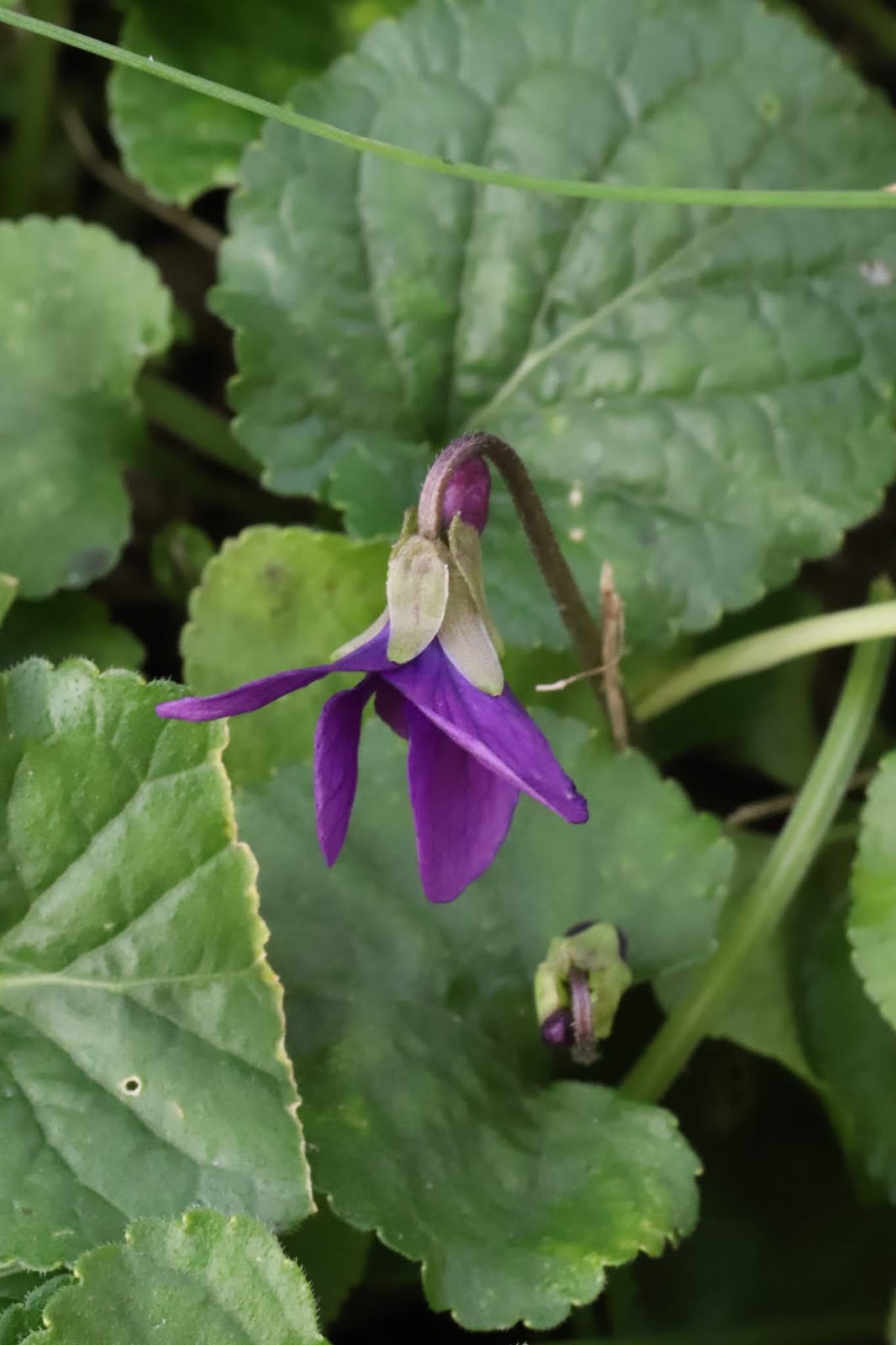
Shade-loving, fragrant sweet violets have spread along the west side of the house forming a carpet because of their powerful way of seed dispersal: their pods snap open, injecting seeds far and wide.


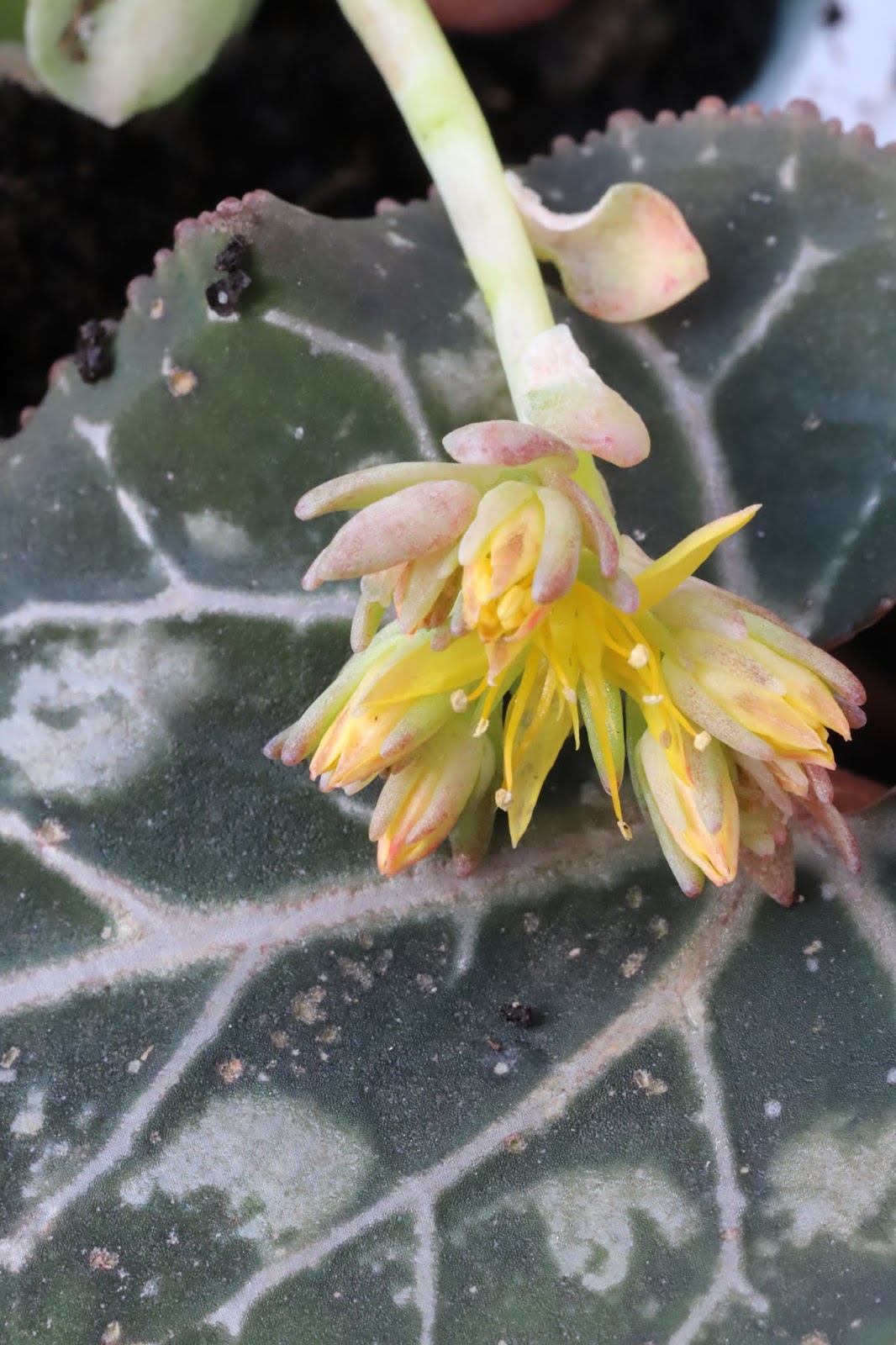
A pop of yellow is always welcome. Thanks, stonecrop!


Each year, I keep adding what is regarded in horticultural jargon as green bones. We talkin' evergreen. One of the older and venerable 'bones' is this yucca which spent the first half of its twenty years in a pot on a Grenoble balcony and the second half in Angoulême soil. It now has several trunks and is close to my height.


À la prochaine!


  • Diana Studer's profile photo
    Will you change from G+ comments on your blog? That is going to sunset too.

    I nurture one pot of violets.
    REPLY
    17h
  • Michelle Beissel's profile photo
    +Diana Studer , if Google allows the maintaining of past comments, then since I hardly get comments outside of G+, I'll opt for the status quo as I really love re-reading old G+ comments when I check past posts (my blog is my recipe book). If not, then all those comments will disappear and that would be sad. Yay for that pot of violets!
    REPLY
    17h
  • Diana Studer's profile photo
    I think the G+ comments will disappear. But there has been NO feedback from Google.
    Maybe edit the comments you value into the text of the blog post? (Which is what I did when I edited posts from my former blog to the current one)
    REPLY
    15h
  • Michelle Beissel's profile photo
    +Diana Studer , excellent idea. Thanks!
    REPLY
    15h
  • Diana Studer's profile photo
    and do it soonish ... they keep jumping the date forward!
    REPLY
    15h
  • Kim Quinn's profile photo
    The hydrangea leaves are so beautiful! I enjoy your posts so much and keep 2 small garden beds, 3x6 and 3x8. They were allowed to rest this past year with a cover crop of hairy vetch, clover, tillage radishes (pods on stems, yummy!) and supposedly field peas. Never saw any of those. It was mixed in April and broadcast over and just whacked 3 or 4 times through the summer when it hit knee height. Now, I am dreaming of herbs, Kale, chard, tomatoes herbsherbsherbs. Wish I had a bona-fide rosemary hedge!💜
    REPLY
    13h
  • Michelle Beissel's profile photo
    +Kim Quinn , thank you so much!

    Your garden interface sounds wonderful (I enjoy whacking cover crops, too). Keep dreaming (and doing). Rosemary is easy to propagate so all you need is a starter plant. If you run out of soil, and you have some cemented area, you can make a potted hedge.
    REPLY

Diana Studer
1 day ago

+
1
0
1
 
Reply

We have a potted hedge on two sides of our kitchen patio. Third side is an in the ground planter (and the fourth is garden) Ours is spekboom Portulacaria afra (which is also edible in salad, a different taste and texture)


Thursday, 17 January 2019

Midwinter Garden 2019

There has been several sunny, not-so-cold days here and there, and when that happens, I am out in the garden cheering on the pallid buds in the daffodil bed. Ten years ago, when arriving at our new home, I began to frame the veggie beds with roofing tiles found heaped in a corner. They have served many a purpose, from preventing our trampling over the planting area, acting as slug/snail traps, allowing the securing of horticultural fleece, and adding a decorative touch.


But they do crack and splinter, needing to be replaced. So out comes the handcart on which the broken tiles get loaded. It is rolled down the garden's length for them to be stacked behind the wildlife area.


Peas need to be planted as early as possible in our climate since it will be too warm for them to flourish by the end of April.  Hence the winter mulch of chipped bark (processed by The Calm One) has been raked to the ends of two beds and the earth spaded. Within a week, the peas will go into the ground and be covered with horticultural fleece which will protect them from freezing temperatures and being eaten by the birds .


Of the fifteen, old fruit trees in less than pristine shape present when we arrived, only a few have survived from being uprooted in storms. One is a purple plum. Another is a peach tree. These two need to be doused with copper (powder mixed with water) each winter twice to prevent leaf curl. The first spraying has been done on a windless, above-freezing-temperature day.


The ivy has set a feast of berries for the birds.


Though I passionately deadhead, I do leave some blossoms to dry on their stems, like this patch of blue asters for their fluffy, white, burst seedpods and as a mulch to protect their roots.


There may be a dearth of colourful flowers, but not of bark, as in this deutzia with its striated tones of apricot and burgundy.


Both the rhubarb and asparagus are putting out buds.


Another flowering plant that escaped my deadheading shears, is a tall sedum (Autumn Joy).


At its base, is a curvaceous cluster of young fleshy leaves.


À la prochaine!