Thursday, 16 April 2020

Covid-19 Cooking: Duxelles

On the thirty-first day of Lockdown in France (Confinement Jour 31), I made duxelles which is a fairly straightforward technique of intensifying mushroom flavour by lessening the moisture content, allowing not only for various uses like pizza topping, pasta adornment, soup and stew enrichment among others, but also for freezing where, because of their reduced state, they won't take up much space. The most important aspect is that the texture doesn't become leathery and tough. You want intense flavour, but tender tidbits at the same time. If most of the liquid already is wrung from them before being sauteed and they are cooked in a large, shallow skillet, the duxelles will be subjected to drying heat for a much shorter time therefore remaining soft despite containing much less moisture.


Ingredients
makes 500 ml/a little over 2 American cups (recipe can be halved)

  • Mushrooms, fresh, 1 kg/2.2 lbs (I chose white button mushrooms, but any edible ones, wild or cultivated, can be used though the taste will vary from mild to strong depending on the variety)
  • Butter, sweet, 3 T
  • Salt, table, 1/2 tsp

As demonstrated by the above list of only three ingredients, this version is the most simple available among numerous recipes. In our household, duxelles is mainly used for pizza topping therefore the plainest form will be more compatible with the garlicky, herb-enhanced tomato sauce and the well-seasoned, often red-wine-enriched Toulouse sausages which also go onto the crust. However, if you desire racier versions, be rest assured they exist with various additions such as garlic, onions, cream, herbs, and booze. Either clean the mushrooms with a soft bristled brush or with a dry paper towel. Slice and then coarsely chop which is just the right size for pizza topping. A finer mince could be more suitable for other dishes.


The cleaned 'rooms are in the foreground, outside the plastic punnet

Drap an old tea towel/dish cloth over a large bowl, pressing it to conform to the bowl's inner contours. Put the amount of chopped mushrooms that can easily fit once the towel is pulled around the mass and twisted closed. Old tea towel you say? Old enough that you don't mind it getting stained, but not so worn and thin that it will tear during the vigorous wringing process.


Squeeze by twisting tighter and tighter and also by massaging the 'bag' with your hands. At first not much liquid will ooze out. After a while, more and more will. Stop when most of the liquid is either squeezed out or you are tired (my preference!). Repeat until all the mushrooms are done. The mushroom liquid is quite plentiful. I couldn't find any information regarding if it could be used in other recipes or if it could be frozen. I am guessing if the raw mushroom liquid is used almost immediately as in a veggie smoothie, than it probably will be okay. Melt the butter over medium high heat in the largest, most shallow skillet you have or work in smaller batches if you only have small/medium sized pans. Add mushrooms and salt. Saute, while stirring frequently, for about five to eight minutes or until the duxelles no longer clump together, are slightly golden, and greatly reduced in volume. Don't mistake their being glazed with butter as moisture.


They then can be portioned and once cooled, popped into the freezer or kept for several days in the fridge.


Though the photo (I forgot to take one of a pizza with duxelles!) below shows how I used to strew a homemade pizza with commercially packaged, pre-sliced, frozen mushrooms which were then thawed before sauteing and added to the yet-to-be baked pie, I ask you to imagine how it would look instead with a dense sprinkling of duxelles applied before baking. Here's a clue: its appearence was charming. Additionally the flavour, texture, and aroma were way up there.


À la prochaine!

RELATED POSTS

Cream of Mushroom Soup Redux


Thursday, 9 April 2020

Covid-19 Cooking: Pea Shoots Soup with Tomato Cream

I am not going to say growing your own shoots, harvesting them, and sieving the fibrous bits from the soup is a doddle in the park. It isn't. But I can say this soup from the first spoonful to the last packs a punch, albeit with a small but determined fist delivered via the combined flavour of the youngest, impossibly fresh peas more akin to green candy than a vegetable and the sweetest spinach without a bit of astringency though neither peas or spinach are included in the ingredients. Add ceps, garlic, thyme, a bit of cayenne or chili powder, butter, and cream, and you have a soup that slams the WOW-meter skywards. One caveat is that it needs to be eaten shortly after being made because its lush, herbaceous brightness fades into increasing and disappointing rankness.


This late winter, three beds of peas were planted thickly so to allow for an abundant pea shoots harvest. In the below photo, the pea seedlings have been thinned to about ten centimetres/four inches from each other leaving enough room for them to mature into pea-bearing plants.


Ingredients
makes four ample servings

  • Pea shoots, fresh, 300 grams
  • Ceps, dried, 2 small handfuls (a gowpen!) plus their sieved soaking liquor, 1.5 L
  • Garlic, cloves, peeled, 2
  • Butter, sweet, 2 T
  • Flour, white, 2 T
  • Thyme, dried, 1.5 tsp
  • Pepper, cayenne, ground or chili powder, a large pinch
  • Cream, 8 T
  • Garnish: tomato paste, cream, and minced pea shoots
  • Salt and freshly ground black pepper to taste

Rinse the shoots well.


Put them on an old tea cloth and with another tea cloth on top, dry them until excess moisture is gone. They will look fluffy and be springy to the touch when sufficiently dry. Chop them fairly finely.


For hydration and separation of grit for the ceps: pour boiling water over the ceps in a bowl and let them steep until the water is coolish to the touch, about fifteen minutes. Work them in the bowl with your fingers and then pour the entire contents into a sieve positioned over a measuring jug. Put the ceps back into the bowl and cover with cool water from the tap. Repeat squishing, sieving, and covering with fresh water till the sieved water is much lighter in tone and you have one and half litres.


Mince them, and also the garlic. Add thyme and cayenne/chili powder. Measure out butter and flour.


Over medium low heat, melt butter. Saute garlic, ceps, thyme, and cayenne/chili powder for about five minutes until fragrant and somewhat softened.


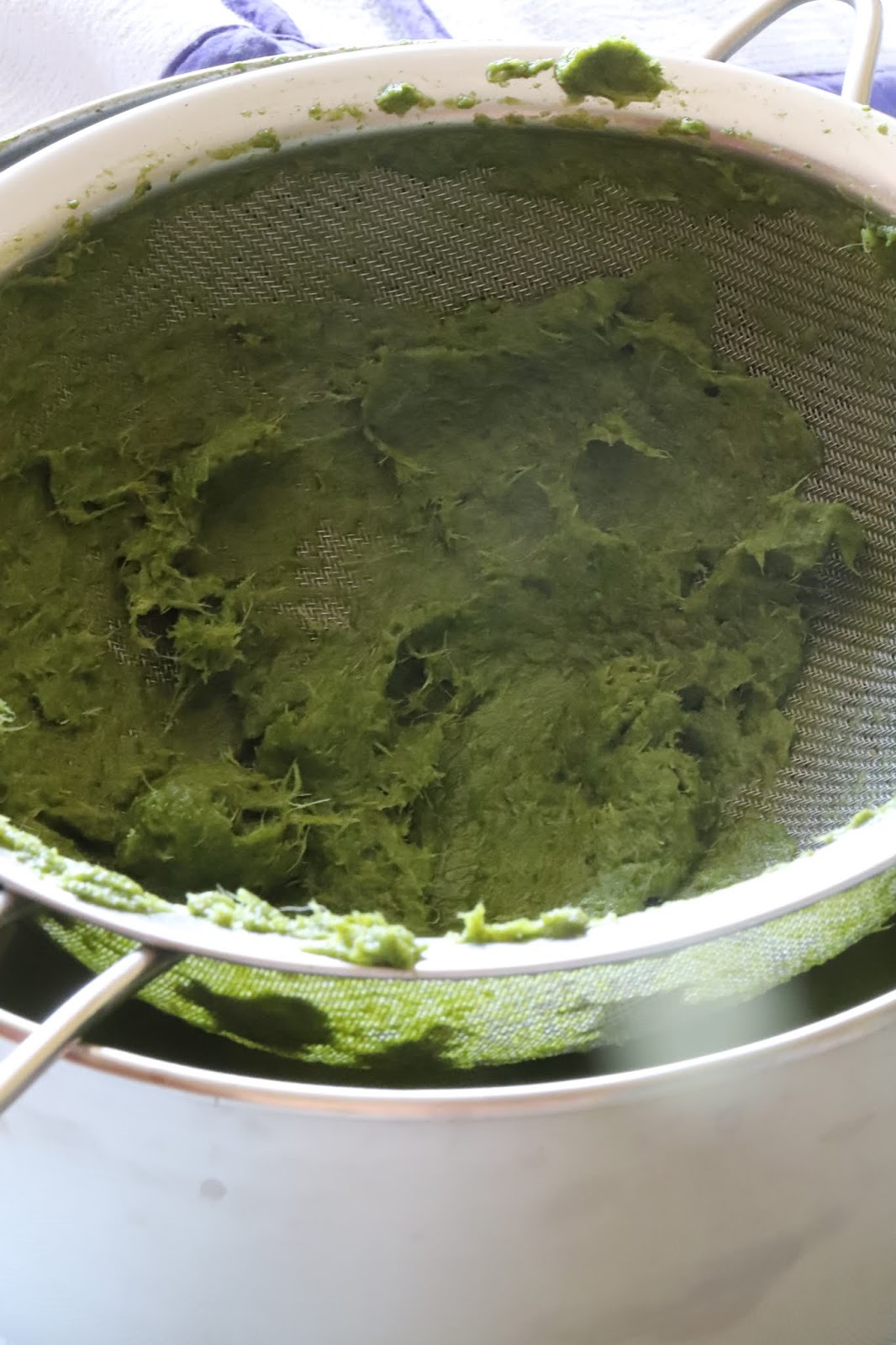
Stir in the shoots. Keep stirring until they cook down significantly, about ten minutes. Stir in the flour. See that brown crust in the corner of my beloved cast-iron pot? Per the gentleman over at his youtube channel, Binging with Babish, that's the wondrous stuff of a chef's dreams, simply called fond.


Add the ceps' liquor which will deglaze the fond, bring to a simmer, and cover. Cook for about twenty minutes. Sieve. Pour back into pot, add cream, and salt & pepper to taste. Reheat if necessary.


Mix about two tablespoon of tomato paste with cream to make the mixture liquid enough for drizzling over a soup serving. In the below photo, it's too thick, but oh so good and would be perfect smeared on hot toast. I just added more cream until it poured from a spoon.


Splotch some tomato cream over a serving and top with a bit of minced pea shoots. I adore this soup. Let's just say this was the closest I ever felt to The Plant Kingdom, and that's coming from one who has been smitten with plants since toddlerhood. I can imagine Treebeard sipping a cup of this and smiling.


À la prochaine!

RELATED POSTS

Pea shoots & Sausage Couscous

Roasted Salmon & Spiced Rhubarb With Fresh Pea shoots


Thursday, 2 April 2020

Covid-19 Lockdown Cooking: Asparagus Soup Redux

Though being able to cook with what you have on hand is a valuable skill in general, as France enters its seventeenth day of Covid-19 lockdown it's even more so because for everybody's welfare you shop for groceries as infrequently as possible. To make do, you cook either without certain items or you substitute with what you do have or you create a whole new dish with what's available chez vous. Creativity, simplicity, and a bit of chutzpa all go a long way. Our asparagus patch have been giving us spears since mid-February.  A large, delectable batch for asparagus soup—deviating from my regular recipe as there wasn't any green onions or cream on hand so several fat garlic cloves and a sizable quantity of very ripe bleu d'Auvergne way too lusty to eat on its own (added in chunks to pureed soup and stirred until completely melted. Wow!) instead were substituted—already has been made and frozen, lying in wait to warm up our bellies during next autumn and winter.

This present batch was made with cream but still no green onions, so lots of garlic instead, and each serving got topped with thin slivers of Coulommiers in lieu of a light sprinkling of crumbled blue cheese. Because the garlic when gently sauteed in butter until soft adds such lushness to the already lush, freshly picked spears, I am thinking that even when food shopping is no longer limited, garlic is much better than green onions! In addition, to satisfy my desire for a thicker, more substantial and nourishing soup with even more asparagus flavour, I doubled the amount of spears. It turned out grand!


One solitary spear makes not a soup.


But a bunch of higgledy piggledy spears do!


Ingredients
makes 4 ample servings

  • Asparagus, green, 1 kg/2.2 lbs
  • Butter, sweet, 50g/2 T
  • Garlic, cloves, large, 3-4
  • Flour, white, 1 T
  • Cream, 2 T
  • Coulommiers or Brie, thin slivers for garnishing
  • Stock made from woody asparagus trimmings, 1 litre/34 fluid oz (see below for instructions)
  • Salt and freshly ground black pepper to taste

Peel and mince garlic. Rinse the spears. Snap off the woody ends and chop them coarsely. Reserve. Cut the remaining tender stalks including their tips into chunks. Put the woody ends/trimmings along with 1 litre/34 fluid oz of water in a pot. Cover, bring to boil, and simmer for twenty minutes. Strain and reserve. Discard the ends/trimmings. Melt the butter and saute the minced garlic over medium low heat for a minute or two until translucent and fragrant, but not browned. Stir in the flour. Add slowly the stock while stirring. Toss in the chunked, tender stalks, including tips, bring to a simmer, cover, and cook for around eight minutes or until tender. Puree with a stick mixer or blender. Season with salt and freshly ground black pepper to taste. Add cream, reheat if necessary, and garnish with slices of Coulommiers or Brie.


À la prochaine!

Thursday, 26 March 2020

Gardening In The Time of Covid-19, Part II: Resilience

Though resilience has always been part of my emotional and mental arsensal since childhood, it has never been more important than now as France enters its tenth day of lockdown. Research shows that elements of resilience can be cultivated, in other words, it's not just a personality trait. Adversity is an opportunity to further learn how to regulate emotions, keep cognition clear and solution-based, and to accomplish goals regardless. The kingdom of plants has held me in thrall from earliest memory. Their flexibility despite being sessile, that is, fixed-in-place, astounds and is one of the attractions gardening holds for me. If the winds buffets them, their elaborate chemistry ensures that their stems thicken to take on the challenge. Some marigold seedlings were started early and put in a cold frame to protect them against frosty overnight conditions, but during the day the tiny greenhouse is cracked open so the wind will encourage their delicate stems to strengthen.


Though fungi are not plants, they certainly are a presence in the garden. They are tough little things living off the fat of the land, like this small scarlet elf cap (Sarcoscypha coccinea) in the wild part of our garden, 'munching' on a dead twig, helping it to become soil. Being in a country with a high standard of living (plus a social safety net), believe you me, there's a lot of 'fat' available to keep us two from shopping and going out on a daily or even a weekly or longer basis. We are checking our immediate environment for ways to occupy and take care of ourselves while sheltering in place so as to keep all of us safe. It's sobering to realise how readily we have regarded superfluous activities and merchandise as necessary.


During the latter half of my forty-five-minute, twilight garden-romp yesterday, the air was filled with the enveloping sound of church bells ringing and ringing and ringing from all directions. I asked myself, has the Pope died, perhaps Macron? I finally conjectured that it had to do with some religious event. Later on, I found out that since Catholics couldn't celebrate Ascension at churches, bells instead were rung all over France to foster a sense of congregation. The below photo shows the part of my 'exercise track' flanking the wild area. I do various sized figure-eights by skirting around bushes, chairs, structures, the many terracotta-roofing-tile-framed parterres, and the driveway which is on a decline, all over the garden plus going up and down the steps leading to the entrance balcony. That blur of green jutting out from the photo's lower right is a plastic pot alerting me to the danger of my possibly becoming impaled in dim light on the double metal arch lying upon its side. The goal is to keep me healthy so I don't bother beleaguered medical staff not to cause a major commotion of someone arriving at the emergency room resembling a vampire who has met her end!


On today's morning, a cold, sunny one, my seeing that our bay laurels were covered in bright yellow flowers was a welcomed sight.


Ten years ago, they were fifteen centimetres/six-inch high seedlings, volunteers from a neighbor's hedge. They are much, much, much taller nowadays.


Their flowers are held in puffy clusters.


Our patio's pergola is covered partially with ivy which has grown up three of its pillars and is now spreading over its upper cross beams. Additionally, on the side facing the garden, it has cloaked a dead honeysuckle vine and a dying rose. With this abundance and structure, I say topiary is in order thusly the rose support is being shaped into a wishbone . . .


. . . and the honeysuckle support into a column topped with a heart.


The upper parts of the three pillars are being trimmed into rounded forms. I love the process of it, that is, their developing a monumental presence under my guidance.


Bearded irises are in full bloom. I put some in a vase near one of the sous sol windows; I shot the photo below from outside, capturing an almost watery reflection. One of the pergola's ivy-covered pillars and a terracotta-roofing-tile framed bed seem to be setting out gentle ripples.


À la prochaine!

RELATED LINKS

How the Pandemic Will End, an excellent Atlantic Monthly article by the very impressive science journalist, Ed Yong. (Paywall is suspended during the pandemic, but registering is required.)

That Discomfort You’re Feeling Is Grief


Thursday, 19 March 2020

Gardening In The Time Of Covid-19*

I have felt a deep affection for our garden during the past ten years, so it's challenging to express how much more I presently love it as France completes its third day of lockdown while spring makes its much awaited appearence.

Foreground: off the patio white sweet alyssum, red tulip, abelia, irises, ivy-covered pergola pillar; background: lawn and that wide, brown smear is the asparagus bed.

Our larder and freezer is well stocked allowing us to refrain from food shopping (which is permitted but only if carrying a self-signed certificate printed from the government's website) which is mutually beneficial for us and others. But fresh can't be beat and the seven-year-old asparagus bed has begun in earnest last week popping out spears. Though their delectable taste lessens each day of storage, cutting off the woody ends (trimmings can be used for making stock), placing the asparagus upright in a jar with 2.5 cm (an inch) of water, and covering with a plastic bag keeps their flavour longer. In this way enough can be harvested to make a soup.


Rhubarb will soon be on its way.


In about a week, pea shoots will be ready for picking. Ah, fresh greens!


In about two months, raspberries born on last season's canes will be ripe. Once harvested, those canes will be cut almost to the ground, and new ones will grow enabling a second crop for September.


Strawberries will be ready by beginning of May.


I haven't planted any new tulips last autumn and hope what is in the ground will do their thing soon. Presently, there are single show stoppers like an Apeldoorn Darwin Hybrid bud peeking out in between an ivy-covered fence and a Leyland cypress hedge . . .


. . . and this sprightly Seadov Triumph tulip sprouting on the compost under a rusty pole . . .


. . . and finally this Purple Dream lily-flowered tulip gracing the front garden.


A sizable expanse of low-growing, evergreen periwinkle (Vinca minor) just off the front entrance staircase is full of their lovely blue blooms. 


À la prochaine!

* Yes, Love In The Time Of Cholera by Márquez inspired my post title!

RELATED POSTS

How To Plant Asparagus


Asparagus Soup and Green Onion Soup

Cantal Asparagus Tart with Creme Fraiche

Baked Parmesan Asparagus Polenta Sausage Frittata


Thursday, 12 March 2020

Thursday, 5 March 2020

Winter Garden Flowers & Café Au Lait

Our urban garden with its golden bed of wind-swept daffodils was strongly blurred behind fogged, rain-splattered kitchen windows this stormy morn.


It's fairly gloomy and has been for months. To cheer myself up I went into my office and peeked out of that window since it's partially protected from rain by a shutter positioned in awning mode, and lo and behold, daffodils in all their bright splendour!


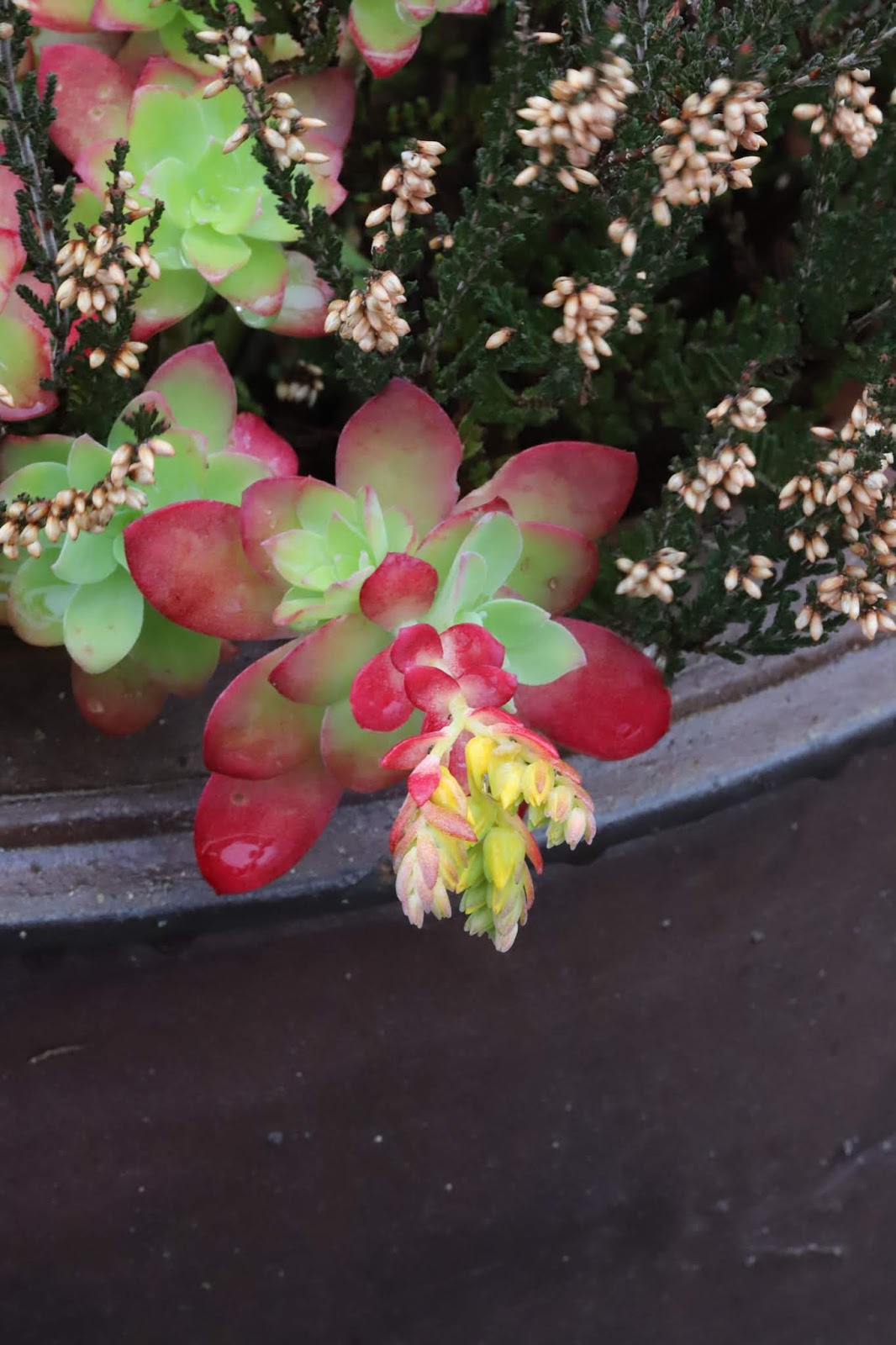
I then realised Eli the Cat was out and about. When I went to fetch him I took my camera because the other day I had noted the luscious burgundy staining the potted sedum's outer leaves . . .


. . .  not to mention their yellow blooms. Its companion, late-summer-blooming pink heather has long since faded to white, but its dark green, needlelike leaves adds a nice contrast to the front garden display.


Upon our return, before I warmed up and cosily steamed up the kitchen at the same time by making café au lait, I towelled off the very wet Eli the Cat, including his paws. Drying him off is not only good for keeping Eli in good nick and not having mud tracked throughout, but also cats get upset when they smell their own fur, which they do when wetly odoriferous, because if they can, other animals not as friendly as moi can too. 

(Ingredients are in bold.) Café au lait is a lovely, lovely, lovely hot drink with a smooth but slightly airy texture. Though fairly simple needing no special machine, it's not just a coffee diluted with lots of milk as its strong taste is still present, but a bit more mellow. It's made by pouring separately and simultaneously one thirds hot, strong coffee, that is, a lot of coffee in proportion to water (I used three heaping teaspoons of freeze-dried coffee for 118 ml/4 oz hot water) and two thirds hot, whole milk (237 ml/8 oz) into a bowl specially made for cupping both hands around the warming surface while they are supported by a sturdy foot. In this sensual manner, the bracing and nourishing beverage is slowly sipped. A spare café au lait bowl can be used to measure roughly separate amounts of coffee and milk before heating them either on a stove or in the microwave in their own pots/containers. The higher the milk and coffee is poured, the more creamy it will be. The Calm One assisted by doing the pouring which was made easier by having the liquids in small pitchers. Alternatively the coffee and milk could be heated together, shaken in a lidded jar for about a minute, and poured into the bowl. It still won't be as foamy as a latte, because after all it is a café au lait.


Often presented as a morning meal, a bowl of café au lait is served with tartines which are slices of bread, either toasted or not, and spread with good things, like butter and jam or if something fancier is desired, with viennoiseries rich in butter, sugar, eggs, like chausson au pommes (literal translation: apple slippers, that is, apple turnovers), pain au chocolate, pain aux raisins, croissant aux amandes, and brioche. Young children usually have bowls of hot chocolate instead of coffee. In my case, I grated some dark chocolate over mine. Freshly grated nutmeg or a mint sprig would be nice touches instead. If I remembered to take out from the freezer the remaining blueberry muffin made with our own berries from last season, I would have toasted and buttered it. I promise you and me in the very near future this will be the case.


À la prochaine!