Showing posts with label Bird Bath. Show all posts

Thursday, 2 January 2020

A Frosty Morn Delights

Frost is captivating. When looked at from afar, it relaxes the mind, slowing down a zigzag of pesky thoughts enough to get to the point of wanting to go on out and get close to it. The laundry can wait. And that goes for checking email too.


Solid ice in the bird bath is thumped out of its giant plant saucer. Shards lay gleaming on the frosted grass; the bath gets filled with fresh water.


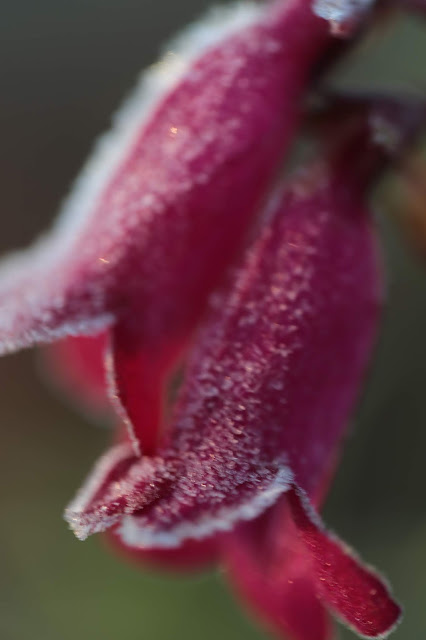
Nothing showcases ice better than the hot pink of penstemon.

There's wind ready and willing to disseminate a dandelion's pollen, but the pollen says not right this moment, but thanks anyway.


A paprika heuchera stuns with picot edging of delicate lace along with a piqué interior of dots. 


A dried sedum clustered flowerhead's swaying in the wind on leggy stems isn't hampered by a newly acquired coat of rime.


Solar lamps encrusted with white accentuate the geometrical purity of a circle and a diamond.


Within sweet alyssum's flowerhead each tiny bloom bears a close resemblance to candied violets.


Weak, wintry sunshine washes over thawed Queen Elizabeth hedge roses facing east in the front garden, fading the vibrant colour into one of old, tattered, salmon-coloured silk.


Pots of lobelia adorning a series of sous sol window sills facing west are still holding onto their blooms since June! Their icy blue fits right in.


À la prochaine!

RELATED LINKS

How frost can harm and help your garden


Thursday, 1 March 2018

Sun Then Snow . . .

Though last week has been cold, I couldn't resist getting bundled up and strolling through the garden. The daffodils waved hello. How can they flaunt such exuberance? It's because last season their leaves were allowed to rot in place so as to nourish the underground bulb which became this out-of-sight powerhouse waiting to generate what we are seeing now: ornate lanterns requiring no light to shine.


Sweet violets are superb ground covers because they are evergreen shade-lovers, have fragrant late-winter flowers that can be candied, and spread readily through ballistic seed dispersal (click here to see it happening) plus myrmecochory (foraging worker ants carry the seeds back to the colony). To maximise flower visibility as the vigorous foliage can obscure the flowers, in late summer I take a line-trimmer to the beds and mow them down to a couple of inches above the ground.


Overwintered blue tansy (Phacelia tanacetifolia) cover crop has done its soil protection job well. Soon it will be cut down and forked in so it can do its soil enrichment task also.


Once ivy reaches the end of its vertical support, it morphs into a robust bush that bears fruit which nourishes birds throughout winter. There's lots of ivy chez nous. Some grows up the pergola's pillars onto its roof. There has been this one starling who I have been observing from my office. She flits in and out of the ivy, plucking and swallowing berries in a flash. Once I witnessed her indulging in a fast food feast consisting of ten berries which she ate in a New York minute.


What beverage to go with that dish of ivy berries, my dear starling? Water, preferably of the liquid kind, please. Freezing temperatures the last few days mean that ice is slipped out of the birdbaths so they can be filled with fresh water.


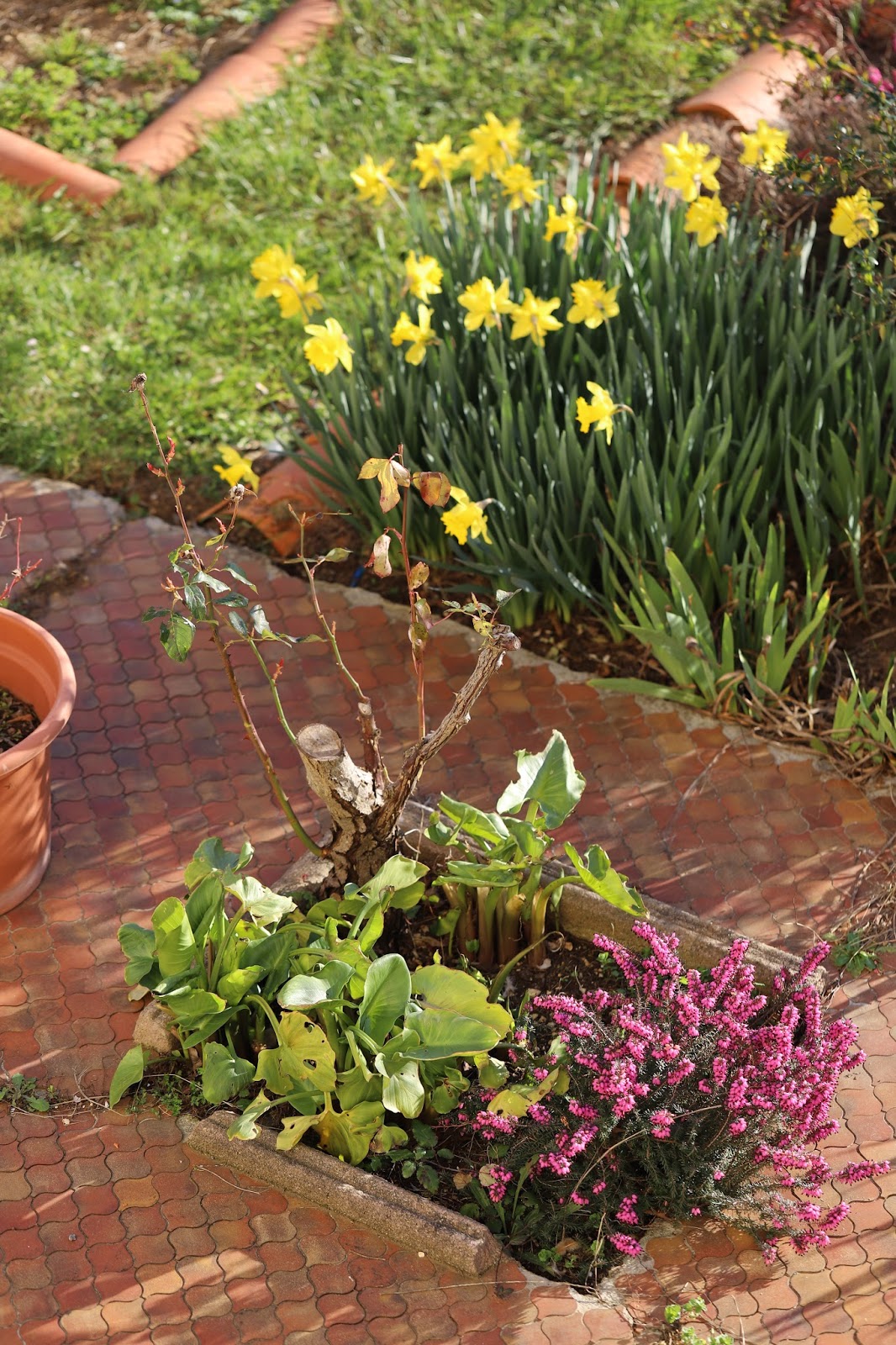
The daffodils and heather cheer me up each and every time I peek out my office window.


Just before the temperature dropped even further, Dirac the Cat, with the aid of fedar (feline radar set for profiting from anything) popped out to relish sunny warmth before . . .


. . . snowflakes came floating down . . .


. . . and kept coming down . . .


. . . until all was leaden grey, but with the dreariness made less by white fluff. By that time, we were inside; Dirac the Cat was munching a treat and I was sipping something gloriously hot.


À la prochaine!

Tuesday, 16 April 2013

Gasp! Thank Goodness for the Gazpacho...and how to plant asparagus

At present it is blistering summer, but a couple of days ago it was a rainy spring, and a few days before, a blustery winter.  A lot of work is getting done despite the heat, downpours, and gale winds.  So much in fact, that even a quickie meal like fritters takes too much time. Since it is summer at present, what better treat than some gazpacho made from last season's tomato harvest?  Thawed and garnished with chopped, hard-boiled eggs/cucumber ribbons/parsley, it is an important reminder why I keep a potager as there is no comparison in taste between store-bought and home-grown toms.


This season's tomato crop has been started already indoors in an incubator and is being taken out each day to get sunshine and mild wind which strengthens their stems.  Presently they are brought back in before nightfall as the nights are still too cool for warm-weather lovers like tomatoes.  So far I haven't left them out shivering overnight--lots of little details a gardener has to keep in her mind!

Roma & Beefmaster seedlings on the right: their second & true set of leaves will appear soon.

This is the season I finally got around putting in an asparagus bed.  Bare-rooted asparagus crowns (modified stems) and their lateral roots are squid-like in appearance.


They were soaked in a pail of water for about a half hour.


The edible part is the young 'fern' which grows from the crown which if not harvested will become about a four-foot-tall, feathery plant.  The spears won't be picked this season and only a light harvesting next spring will be done so their roots will become strong to encourage robust, future yields. Asparagus is one of the few vegetables that are perennials, and this bed should produce for the next twenty years.

This baby asparagus is white because it was stored in the dark.

Two six-inch-deep and foot-wide trenches were dug flanking the long sides of a spaded block bed. An organic fertilizer with a balanced NPK was sprinkled in them. Then a light covering of soil was put down to protect the crowns from getting burned.  Weeds are hard to pull from the dense matting of underground roots, so hopefully a close planting of asparagus in a block bed will work against weed growth.


The crowns were then place about a foot apart and covered with a few inches of soil.  As the spears come up, I will keep adding soil until the plants are well mounded.


Twenty one asparagus crowns out of sight and awaiting further filling in with soil.

The removed soil are in a couple of covered, nearby crates.

The sweet alyssum planted last spring and which is usually grown as an annual was able to survive through the mild winter.  If well trimmed to encourage new growth, they should last another summer. The air is touched with their honey fragrance which bees adore.


Instead of replacing the well worn, forty-year old patio, I sow alyssum in the cracks. 


Weeds are dug/scratched out with a sturdy knife, potting soil is put in the cracks, the seeds are sown, then covered up lightly with some potting mix and watered.  Be sure to block off the area until the plants are established. Because they are not really perennials, I will eventually plant mother of thyme--I finally located an online source for it--in the various cracks.  It is a sturdy, creeping, evergreen, drought-tolerant thyme which can take some foot traffic while releasing its bracing fragrance when crushed underfoot.

A milk bottle with its cap punctured with tiny holes makes a nice sprinkler.

This is the spring I will finally get around to putting soil in the pockets of this porous, crumbly rock in the front garden so I can sow alyssum in it also.

Left side of the walk is weeded, the right side will be--those floppy plants are wild garlic.

Some of the nine fruit trees are blossoming.

The tallest of the two pear trees.

The smallest of the two apple trees.

The bearded irises are close to blooming in azure and dazzling profusion.


The lilacs are waking up. 


Increasingly animated birdsong reminds me to keep the bird baths filled with fresh water.

DIY bird baths:  upturn a large planting pot, top with its saucer, & add a rock for a perch.

Unfortunately, the last shipment from the nursery has not arrived.  When it does, I will be occupied with getting onion sets, three varieties of potatoes, and bare-rooted blueberry plants settled in their new home.  Until then, the main tasks in the potager are weeding, mulching, indoor sowing, fertilizing, strimming, and transplanting.

Strawberries, peas, radishes, beets, carrots, and garlic are in the various beds.

Dayo of course works as hard as I do and when he gets a bit fatigued is fond of resting his head on a terracotta pillow.


À la prochaine!

RELATED POSTS

How to make gazpacho
Sowing carrots
Planting garlic
Indoor sowing