Tuesday, 6 May 2014

Pasta with an Asian Touch...and the flowery spring garden

It's been awhile since I have discovered tagliatelle goes well with red pepper flakes, garlic, and ginger. This time, however, I added pea shoots, soy sauce, and omelette strips.

Soy sauce imparts a lovely golden colour

While the pasta--throw in the shoots after five minutes--is cooking, make a thin omelette with one or two large eggs. When it is set, flip over and brown that side. Remove to a cutting surface and let cool a bit. Slice into long, one-inch-wide sections and reserve.  Mince pepper flakes, garlic, and ginger and saute them lightly in a little oil in the omelette pan. Add a few tablespoons of the pasta cooking water. Toss the tagliatelle, shoots, and egg with the garlic, red pepper, and ginger in the skillet. Sprinkle, or in my case, slosh with soy sauce and stir well.

The flower garden is coming into being with such ease -- mostly pink there, red here, and white over there but also with a splash of blue and a glint of gold.

Cottage pinks are good for hiding the knobby knees of rose bushes

Roses are continuing to astound. The seven Queen Elizabeth hedge roses are in the middle of their first blooming flush. We should get several such flurries of pinkness until autumn.


I suspect this glowing, deeply coral-coloured rose is Tropicana.


The repeat-flowering bourbon rose, Ferdinand Pichard, is a robust bush with clusters of fragrant, white-and-red striped blooms.

The cute bud on the right can't wait to embrace maturity

Cottage pinks (Dianthus plumarius) rank way high on my favourite flower list. They are not named for the colour pink but for their distinctive edging, as if a pinking shears had its way with them.

A double blossom variety with a red center and petals flushed light pink

Sweetness cottage pinks will flower all through the summer and autumn. Like many varieties of this species, they are easy, evergreen, and rewarding perennials, that is to say, they will give many, many, many, fragrant flowers that come back again and again and again. However, these are the only variety that will put on a summer display from seed planted in late winter. With all the others, the propagation can be done more easily via cuttings from a few nursery plants. 


The messy split calyx of Mrs. Sinkins cottage pinks is more than compensated by its fabulous fragrance.


Miniature glads chez nous prefer to volunteer in already densely planted beds, especially of the iris and lavender persuasion.

Behind the gladiolus are early season potatoes

Though I sowed soapwort last spring and transplanted them just this past autumn, they are already generously covering not only the ground but their own foliage with pink flowers.

A soapy liquid can be made by boiling crushed leaves and roots in water

Herbs like thyme and sage (below photo) contribute to the flower show by happily presenting some blues now that the irises, bluebells, and lilacs are no more.

Can you spot the small beetle-like insect?

It is always a thrill when the fruit-bearing stock of our garden show their abundance of flowers/immature fruit.

Grapes!

The green fuzzy ovoid is a peach-to-be.


A soft wave of white petals is harbouring the developing blackberry.


À la prochaine!

Tuesday, 29 April 2014

Griddle Cakes...and roses & calla lilies

At the start of an intensive gardening day, I sometimes make fortifying American pancakes especially since The Calm One has secured a reliable Canadian maple syrup connection here in France. The puffiness of griddle cakes differentiates them from European crêpes which means baking powder/soda is a necessary addition. The dry and wet ingredients require just a light mixing--a tiny lump here and there only is assurance the pancakes will be of a tender texture. If even more airiness is desired, then the eggs can be separated and the beaten, stiff whites folded into the batter. Each griddle cake was anointed with a pat of sweet butter, then stacked, and lastly the pile was gloriously drenched in one-hundred-percent-pure maple syrup.


I use the recipe from my culinary bible, The Fanny Farmer Cookbook, which is as follows (including variations):

Ingredients
(Makes 16 small or 8 large cakes--I halved the recipe using one egg to get about 8 small ones)

Milk, 1/2-3/4 cup* (1-13/4 dl)
Butter, melted, 2 T
Egg, 1 (I used large)
Flour, plain, white, 1 cup* (140 g)
Baking powder, 2 teaspoons
Sugar, 2 T
Salt 1/2 tsp
*American measure, that is, 8 fluid ounces equals a cup

The amount of milk you use will determine how thick these griddle cakes or pancakes are. Start with the smaller amount suggested and add more if the batter seems too thick. Try to have the milk at room temperature before mixing... Serve with maple syrup or honey.

Beat the milk, butter, and egg lightly in a mixing bowl. Mix the flour, baking powder, sugar, and salt and add them all at once to the first mixture, stirring just enough to dampen the flour. Lightly butter or grease a griddle or frying pan and set over moderate heat until a few drops of cold water sprinkled on the pan form rapidly moving globules. If you wish small pancakes, drop about 2 tablespoons of the batter onto the pan, or pour about 1/4 cup from a measuring cup if larger pancakes are desired. Bake on the griddle until the cakes are full of bubbles on the top and the undersides are lightly browned. Turn with a spatula and brown the other sides. Place finished griddlecakes on a warm plate in a 200 degrees F (95 degrees C) oven until you have enough to begin serving.

Buttermilk Griddlecakes. Use buttermilk, sour milk, or yogurt instead of milk and substitute 1/2 teaspoon baking soda for the 2 teaspoons baking powder. Note: I diluted the yogurt with a little water to get a consistency similar to buttermilk, and the cakes turned out very well. Baking soda is activated by the presence of acid in the soured milk products.
Whole-Wheat Griddlecakes. Use 1/3 cup whole-wheat flour and 2/3 cup white flour. If you wish, sweeten the batter with 2 tablespoons molasses or honey instead of sugar.
Oatmeal Griddlecakes. Heat the 1/2 cup of milk, stir in 1/2 cup quick-cooking oatmeal, and let stand for 10 minutes.  Add the remaining ingredients, reducing the flour to 2 tablespoons.
Buckwheat Cakes. Use 1/2 cup buckwheat flour and 1/2 cup white flour.
Apple Griddlecakes. Peel 1 tart, juicy apple, cut it in thin slices, and stir it in.
Blueberry Griddlecakes. Add 1/2 cup blueberries. If you use canned blueberries, strain them before adding.
(p. 496, 1987 hardcover edition)

Decades ago, I had the pleasure of renting the top floor of a Brooklyn townhouse owned by two sisters of Italian ancestry called Rose and Lily. They grew thyme, rosemary, and marjoram in their garden and carefully dried them in bunches hung around their ground floor apartment. An offering of a syrupy mint cordial regularly enticed me into their meticulous abode. My having so many small glasses of the delectable liqueur had Rose joking in her earthy way that my pee would turn green. Now I am in the southwest of France in our own house and growing/drying herbs and surrounded by roses and lilies!

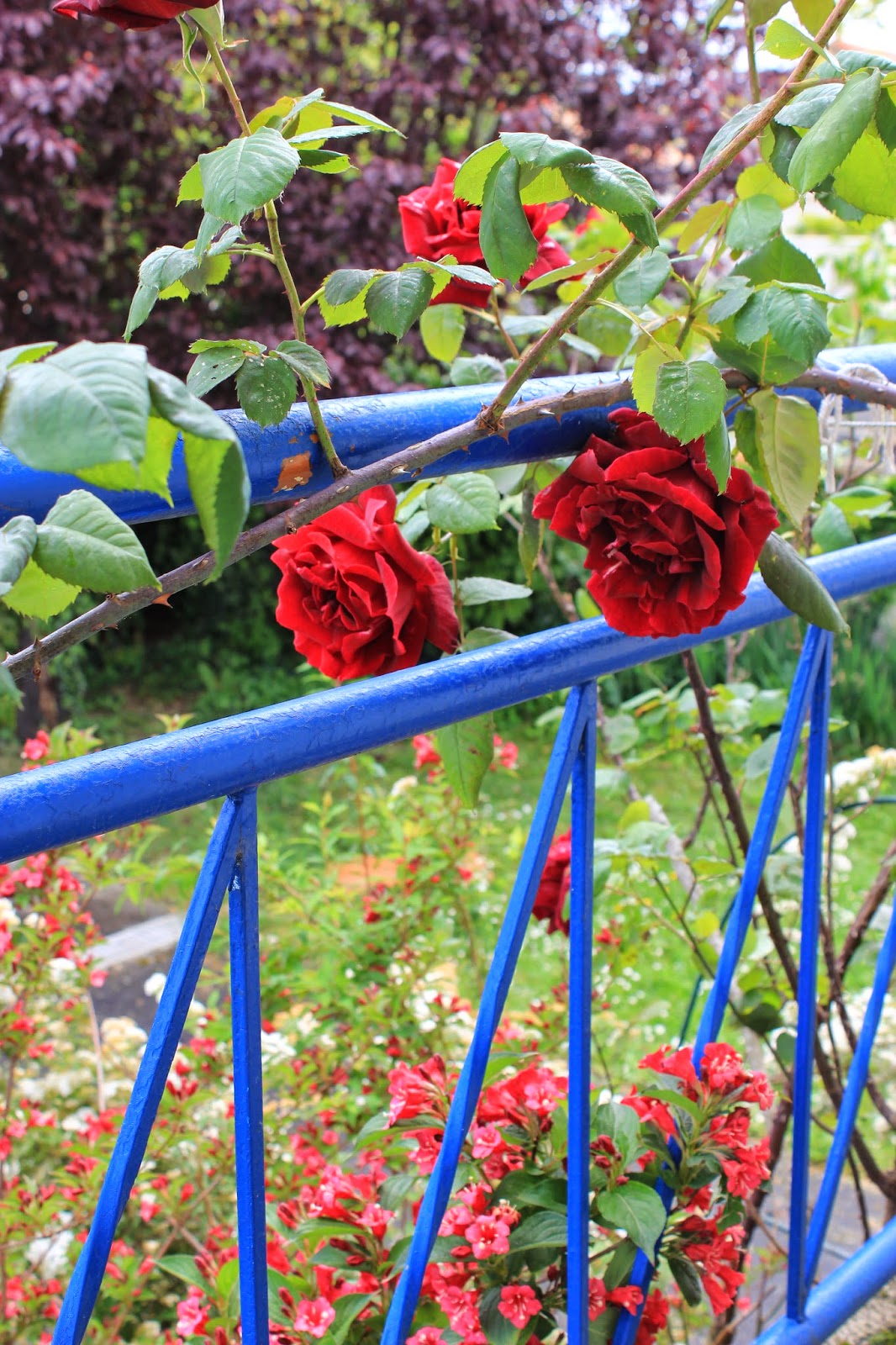
L'etoile de Hollande so far has been the most magnificent surprise in our garden. When arriving here four years ago, we saw a scraggly, scrappy, tangled, not very tall network of spindly branches that gave forth one rose. But what a rose it was! Boasting a diameter of five inches, the plushest, dark red petals, and a captivating damask fragrance, a single flower was enough.


It was only this year after continuing care on my part and abundant rain that it finally claimed the entrance balcony rail as its rightful domain. We now have over a dozen in full flower with numerous blushing buds-in-waiting.


This rose is a robust climber. A present it is about twelve feet above the ground.

That's a white spirea and a red weigela below the balcony & a purple leaf, ornamental plum

Another luminous beneficiary of the plentiful rain is calla lily. They love moist but well drained soil which means if I don't remember to water them copiously each day during our long, hot season, they sulk. When we lived on the Oregon coast, they did so well in our garden that I referred to them as the Calla Forest.

One of the two original clumps which came with our place

This adventurous one settled down on its own initiative far away from its home to a small square oasis smack in the middle of our 'ancient' terracotta patio which most likely appealed to this plucky seed because I tend to remember to water this area.

They share precious space with some rambunctious cottage pinks

The main inhabitant of this little green spot is a tall Queen Elizabeth hedge rose whose shadow gracefully provides some dappled shade for the Callas.


The rose bush is about eight-feet high and is just starting to put out its first blooming flush for the season.


Though it is possible to propagate callas by seed as the gracious oasis volunteer has managed to, it is usually accomplished by dividing its rhizome like I have done with these transplanted near a camellia and some sweet violets.


My favourite sedentary spot in the garden has now become this 'alley' which runs along a side of our house. Brimming with pleasant thoughts, I sit here most days...

Behind the chair: sweet violets, irises, glads, roses, callas, lilacs, aucuba & an ivy-covered tree trunk

...gazing at the garden 'major' glistening and sparkling as the sun sets.

Falstaff rose, Mrs. Sinkins cottage pinks, culinary sage, various veggie beds & mass of white English daisies

As the twilight deepens, so does my peaceful joy.

The tent of horticultural fleece is keeping tomatoes snug

This was the first time I managed to plant potatoes as early as February. The Dolwen variety has just begun to flower which means some primeur potatoes will be ready for harvesting in several weeks.

Rose and Lily would have approved of the flowering thyme in the upper right!

À la prochaine!

Wednesday, 23 April 2014

Pea Shoots & Sausage Couscous...and a rosy beginning

The second tub of potted pea shoots is just coming up now while the first one is renewing itself for an eventual second harvest. Couscous (recipe) takes under ten minutes to make so it is often found in our grain-based quick meals.


Recently having made mozzarella, mushroom, and sausage pizza (recipe), I reserved some sauteed Toulouse sausage for other uses. Hence I was focusing on an oriental flavour involving garlic, red pepper flakes, soy sauce, pork, and pea shoots.


While the couscous is being prepared, saute in oil (I used olive) some minced garlic and red pepper flakes for a minute or two.


Toss in some rinsed, chopped pea shoots and the already cooked sausage, stirring for a few minutes. Keep warm until the couscous is ready.


Spoon a circular bottom layer of couscous and then some greens and pork in a smaller diameter. Do another of couscous in an even smaller diameter and top with the pork mixture. Splash well with soy sauce.


In the garden, though the temperatures can go as low as forty degrees Fahrenheit at night, the day temperatures are in the seventies therefore the roses are gradually waking up from their long sleep, the little beauties that they are.

A David Austin climber: fragrant, quartered, velvety Falstaff

Chicago Peace

The profusion of irises are lessening somewhat...


...though still keeping me busy with deadheading.


Though many would suggest splaying or crushing the ends of lilac stems to increase the length of time their flowers will keep perky, I found that it does not make much difference.  If I get twenty-four hours of violaceous stamina from them, I am a happy woman.

When newlyweds, we bought that vase at a California Macys about a quarter a century ago!!!

The Spiraea prunifolia gracefully drooping its precious weight of white blossoms resembles a huge bridal bouquet.

That's a shade-loving Lamium galeobdolon on the lower right

The thirty or so tomato plants sowed indoors in the incubator about seven weeks ago are in the process of being transplanted into their beds.  The last several nights were cool enough to justify covering the yet to be staked, tender plants snugly with horticultural fleece.

Monflavet, an early season tomato

À la prochaine!

Wednesday, 16 April 2014

Pappardelle, Pea Shoots & Creamy Tuna Sauce...and irises, irises, irises!

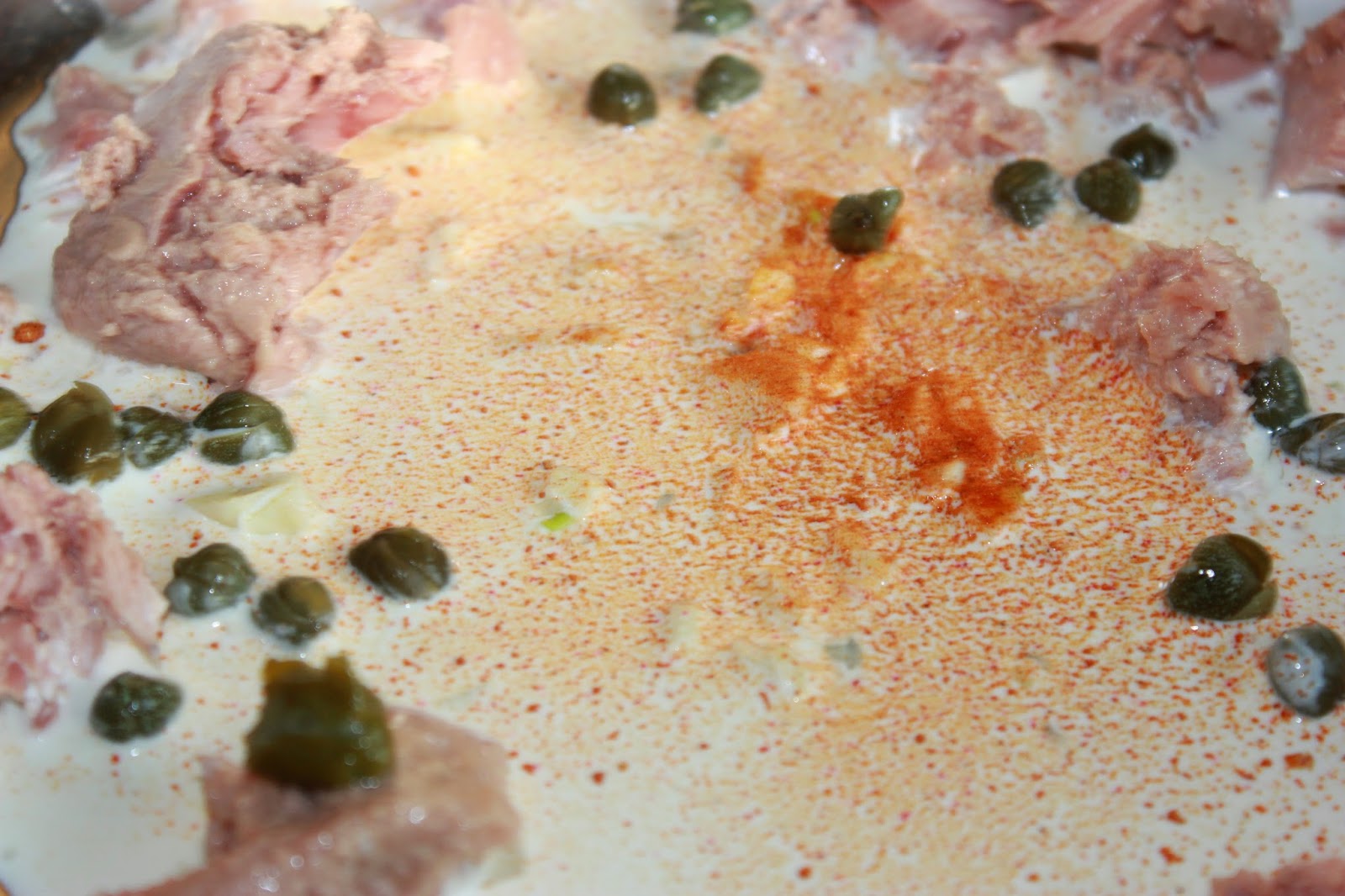
After recently making the dumplings for our borscht (recipe), I found myself with a surfeit of dough. The more uncommon pasta like wholesome, comforting pappardelle is not easy to find here, so being a hedonistic opportunist, I pinched off a bit of dough, rolled it out until the sheet would not get any thinner without disappearing, and cut it into one-inch-wide strips. The next several days I kept on hammering out pieces of the dough until it was no more and adding to the pasta whatever fresh greens were available from our garden. The toppings were various easy-to-make sauces. One version was tossed with pea shoots and a creamy tuna sauce studded with capers and spiked with paprika and garlic.

The paprika imparts a pleasing rosiness to the sauce.

This is the first season I have potted up some pea seeds just for picking their shoots. I snap off several inches from the top, ending just above the next leaf. Before the summer heat wilts the plants, there should be several harvests.

They can be eaten fresh or cooked and are one of my favourite greens as they are so delicate in taste

In addition, I sowed the usual bed so the plants can form pea pods.

English daises galore, pea bed on the right, raspberries, bluebells, and wildlife area in the back

A golf-sized ball is enough for one serving.


Bring some water to the boil. Roll the dough out on a floured surface until it is fairly thin, but feel free to experiment with the thickness you like which is something you can't do with store-bought ones.


Put a few tablespoons of cream, a teaspoon of capers, a minced garlic clove, some paprika, a tablespoon or so of the pasta cooking water, and mashed tuna in a skillet. Heat gently while stirring. Add salt to taste.


Toss a handful of rinsed shoots in first and cook for about a minute.  Fish out and reserve.


Lower each noodle slowly by hand into the boiling water. As it cooks up fast, sticking will be kept to a minimum. But still give a judicious stir here and there. Depending on the thickness, only a minute or two of cooking is needed as fresh noodles are done quickly. Scoop out the papparelle with a pasta fork or drain them.


Mix the pasta and shoots together and top with tuna sauce. So simple, so fresh, and so good!


The irises are the stars at the moment in the garden. There are just two varieties--an earlier blooming, taller, silky two-toned violet-blue and a deep, velvety purple.


Anticipating the unfurling of such a tightly rolled bud is as thrilling as watching a fashion designer slowly shaking out a bolt of purple velvet.


The furry white tongue on the lower petal is the 'beard'


The lilacs do have a supporting role in the flower flick that is running in our garden.


But the roses are promising to be the scene stealer.


Hanging out the laundry in the brisk spring wind while being regaled with the bearded irises' perfume--similar but headier than that emitted by Lily of the Valley--is one of the biggest joys ever!

Apple tree is just starting to flower

As there are about seven buds on each iris stalk, the faded flowers wrap themselves around yet unopened buds. However deadheading so many flowers is eased because of their fragrance. As I will often tightly clutch huge quantities of them while working a bed, my hands end up looking like this:

Note to self: when deadheading irises wear old, dark clothes and not white clamdiggers!

The broccoli planted last autumn went fully into flower providing a wonderful colour complement for the bluebells and irises.

That's a strawberry bed close to flowering behind the yellow riot

The impertinent splash of red just above the irises is a rose impatient to audition in our garden's cinematic endeavour.

The spring garden is beautiful, non?

À la prochaine!