Thursday, 28 July 2016

Midsummer Garden

The potager is brimming with potatoes, tomatoes, garlic, onions, beets, green beans, and carrots close to harvest in addition to plums, peaches, and blackberries. However it quickly can become desiccated because rainfall is infrequent during July and August. Hence my morning and nightly dates with the water hose because during those times the rate of evaporation is less. Thinning beets are advantageous in two ways: allows room for the remaining to become full-sized and gives abundant greens for the cook pot.

I prefer beet greens to spinach though I would never refuse the later

A chiffonade is an effective way to cut herbs and leafy greens by stacking them in a pile, rolling-up that pile up into a fat cigar, and then thinly slicing it.


Cold drink and food are refreshing ways to withstand hot days, but a different response works also which is surrendering wholeheartedly to the heat and melting along with it till the only reasonable response is a nap. And to aid that giving-in is a nice soup plate of minestrone containing among other ingredients, beet greens, basil, and potatoes from our garden.


Tomatoes which were planted late in the season due to unfavourable weather are beginning to redden.


Happily there were enough ripe ones to slice for topping macaroni and cheese.


In order to stay bushy, and therefore productive, spearmint is no different from other herbs which all require frequent pinching. These leaves got washed and then towel-dried. Spread evenly on a plate, they lost all moisture within two weeks. There is now a filled jar chez nous that will provide some lovely iced mint tea.


Some of the strawberries put out baby plants, from three to five on a runner, which were cut off and placed in shallow flats of potting mix. They will be planted in about a month.


The lush, silky blooms of the hydrangea have reached their peak.


Dirac the Cat loves twilight and twilight loves him, bringing out the blue in his coat.

The wild area and dusk is a perfect pairing for him

He doesn't need warm food to go with the flow, just a good stretch thank you very much.


À la prochaine!

Wednesday, 20 July 2016

Fresh Berryade

Each summer I reserve enough blueberries harvested from our potager to make blueberry cupcakes, and each summer I actually make something else with those precious berries. Something cool. Something that doesn't require any more baking than the self-roasting I have achieved by picking them in the hot sun. Something which highlights their sparkle and tart sweetness.

Thirty-year-old pitcher with FRESH juice

INGREDIENTS
per sweetness and consistency desired, makes a pint to a quart

  • 3 cups of berries (several large handfuls)
  • simple sugar syrup made from 1 cup sugar/1 cup water (mix in pot, simmer until mixture is clear, about five minutes)
  • berries for garnishing
  • additional water for desired dilution

A few raspberries and strawberries along with a handful of blackberries were added to the abundant blueberries.

All from our potager

Eschewing various aides of the electric persuasion, I just put the sieve of washed and trimmed berries over a mixing bowl. My fingers did the rest. You be surprised how much fun it is to squash them, especially the blueberries, almost equal to the pleasure of popping bubblewrap. Those grape-stompers have nothing on me.

This gorgeous pulpy mass will find a loving home on the compost pile

A fork and a wooden spoon was used at the end to finish mashing and to press juice through the sieve. Make sure to use a clean spoon for scraping the outside of the strainer.

Burgundy bliss!

With a small amount of syrup and water added, the 'ade was closer to juice. With more syrup and water, it became cloudy, somewhat dulling the fresh edge, but still so much better than any packaged/bottled versions. If the syrup, berries, and water are cold, then one can enjoy it right away. If not, refrigerate or add ice.

The pink froth tickled in a welcoming way

In the potager, various plantings done in March and April are either close to harvest like onions and potatoes or are being harvested as in the case of shallots. They are a valued ingredient for bringing a delicate piquantness to dishes. For my first crop, I had chosen a rose-coloured variety. It seems that the grise (gray) shallot is more esteemed so I will try those next season.

Jermor variety curing in the shade

Basil, like all annual herbs, need to be pinched back frequently to keep the plants nice and bushy. When I have some in hand, I sneak them in wherever I can, for example, by tucking a few leaves in grilled cheese sandwiches.

Next time, I will add minced shallots

During a late-evening perusal of the garden, I was delighted to see flowering fennel transforming itself into the likeness of a delicate Asian print.

Living artwork flanking one side of our house

In the flower garden, a trio of lavender, perennial snapdragons, and roses form a calming melange.


In the front garden, hydrangeas add a bright accent to foliage, rocks, and brick path.


À la prochaine!

Wednesday, 13 July 2016

Ravenous? Try Raviolone!


Though I always wanted to be delighted and charmed by dainty ravioli, I never have been. From both a chef's and eater's view, there's too much fastidious detail for so little gustatory payback. Discovering raviolone recently which can vary from dinner-plate to serving-platter size delighted me. A traditional filling contains soft cheese like ricotta or mozzarella burrata while raviolone d'oro boasts of an egg yolk nested in the white mound of milky goodness. Greens are also another familiar addition. Using what was available in our kitchen and garden, that is, regular mozzarella and radishes including their tops, I made what will be the first in a long line of beauties. So many fillings, so little time.

Well-stuffed, simmered then sauteed in butter, and dusted with seasoned Parmesan bread crumbs

INGREDIENTS
makes one six-inch diameter raviolone

  • Mozzarella, coarsely chopped, a handful
  • Radishes and their greens, one bunch
  • Pasta dough (see below)
  • Parmesan, 1 T mixed with bread crumbs, 1 T
  • Black pepper, freshly milled
  • Butter and olive oil for sauteing

When making pasta without a machine, adding egg or oil or milk to the flour allows the dough to be rolled-out thinly. Since there was surplus dough from making beef & onion pierogi for borscht (recipe is here though some photos in this old post are corrupted, text is correct), I used that. Mix 300 grams of all-purpose flour with 1/2 tsp salt and 160 ml milk which is plenty for two raviolone. Knead until smooth and elastic which takes about eight minutes. Extra can be frozen. Roll-out as thinly as possible two circles six inches in diameter. In other words, if you think it is thin enough, it's probably not so flip it over and roll again. Keep repeating until the dough just can't be stretched any further. Saute chopped radishes for a minute or two in some olive oil. Then add their chopped greens, cover, and simmer for a few minutes more. The radishes become tender and somewhat sweet while their greens have a nice peppery bite. Drain/press-out any liquid. Mix with the mozzarella. Salt to taste. Leaving room around the edges, place the filling.


Moisten the edges. Put the second round on top, pressing down to eliminate any air bubbles. Do a decorative edging with a knife or a pizza cutter. Seal with a fork all around.

A starfish in the south seas?

Using a wide spatula, ease the raviolone into boiling water. Simmer for about eight to ten minutes. It will rise to the top and look a bit shiny when it's done.


Put some butter in a frypan and saute the raviolone for a minute or two. Grind black pepper on top.


Towards the end of cooking, sprinkle the bread crumbs mixed with Parmesan.


Slicing into its steamy abundance was thrilling and . . . 


. . . and so satisfying.


What would be a perfect follow-up to the raviolone? Strawberries, raspberries, and blueberries fresh from our potager of course!


My entreating The Calm One to whip up a batch of his luscious Creme Chantilly made it even better.


À la prochaine!

Wednesday, 6 July 2016

Tuna Cakes with Gooseberry/Sage Sauce

Gooseberries, informally known as goosegogs, enhance desserts with their tart freshness. They also do the same for savoury dishes, especially those featuring pork or fatty fish.


Gooseberry/Sage Sauce
makes 8 T (freezes well so extra can be made)

  • Gooseberries, a couple of handfuls
  • Sugar to taste
  • Sage, a minced fresh leaf or two/pinch of dried

Put berries along with a tablespoon of water and a good sprinkling of sugar in a pot. Since the sauce will be sieved, there's no need to remove their pesky tops and tails.


Bring to a simmer. Cook gently while stirring here and there for about ten minutes until mushy. Add sage and more sugar if desired.  Sieve via a mesh strainer or a food mill. Refrigerate (best if left overnight) or freeze.

Delectable! And made with gooseberries & sage from our potager

Tuna Cakes
makes three 10 cm/4-inch rounds (can be doubled & quadrupled, but use no more than 2 eggs)

  • Tuna, canned, drained, 100 grams/3.5 dry ounces
  • Egg, 1
  • Parmesan cheese, 2 T
  • Breadcrumbs, preferably homemade, 4 T
  • Onion, finely minced, 1 heaping T
  • Freshly ground black pepper
  • Lemon juice, 1 tsp
  • Vegetable oil (I used sunflower) for frying
  • Fresh sage leaves for garnishing

Breadcrumbs are easy to make and so much better than store-bought. Tear bread (I used a baguette), stale or fresh, into small pieces, spread evenly on a shallow pan, and bake at degrees 120 degrees C/250 degrees F for about thirty minutes or till golden and crunchy. Stirring the crumbs a couple of times while baking helps the process.  Cool. Crush with a rolling pin, or in my case, roll them with the jar that eventually stored the crumbs! They will keep for several months either in the cupboard (if weather is not humid) or in the fridge.


Beat the egg and lemon juice together. Add the Parmesan and crumbs. Mix to get a pasty texture.


Stir in carefully the onions, tuna, and freshly ground black pepper.


The consistency needs to be moist but still a bit crumbly. Divide mixture into thirds. Form three balls and then flatten out to about an inch/2.5 cm thickness, patting and shaping for cohesion. Reserve on a plate.


Since The Calm One and I are both thrilled with our ceramic knives, we got a ceramic frypan to see if the thrill continues. It does. He also found an one-piece spatula that is versatile, sturdy, and flexible. It can scrape the film that scrambled eggs leave, handle plus cut sticky, no-knead bread dough, and flips with uncanny accuracy. Lovely thing.

Both utensils are from Lidl. Don't have one in your quartier? Consider moving near one!

Pour a thin film of oil and heat for a minute or two till sizzling hot. Add the cakes. Brown over moderate flame about three minutes on each side.

Great ceramic skillet! No sticking and easy to clean.

How to get a nice crusty outside? Just include some breadcrumbs in the mixture! So more simple then coating the actual patties with the stuff. Cover with sauce and serve any extra on the side. 

Pairing fish and gooseberries turned out sublime

À la prochaine!

Wednesday, 29 June 2016

Culinary Experiment: All I got Was Aligot & It Was Enough!

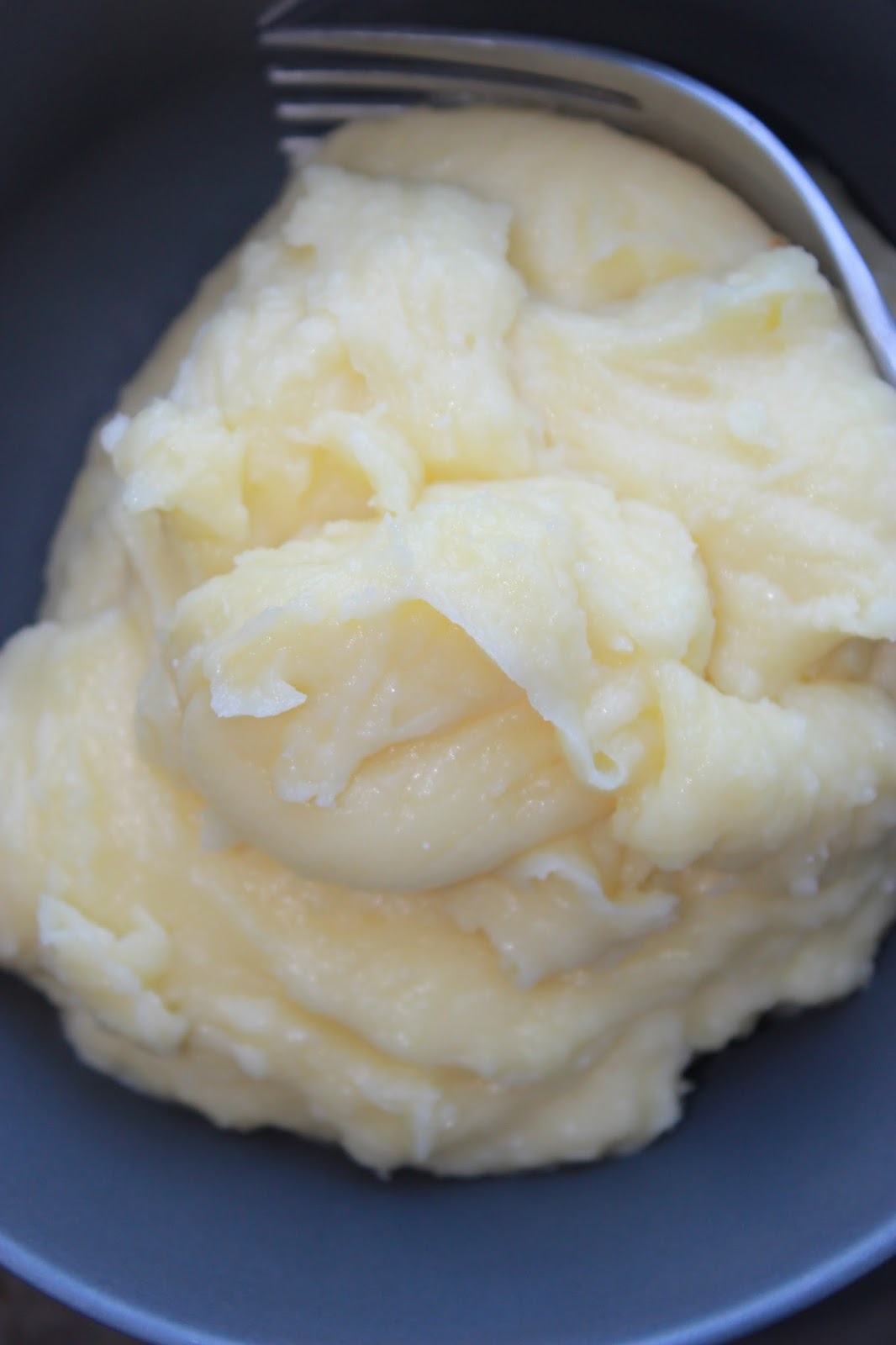
Many a moon, I have been musing about making aligot. Consisting of potatoes, butter,  crème fraîche, and cheese, it's a redolent-with-garlic speciality from the L'Aubrac region in southern France. If there is one dish whose taste and texture comes together in perfect harmony, it's aligot.

Not quite mashed potatoes, not quite a fondue

An early-season potato, Artemis, recently gave a decent harvest. Because its moisture content is moderate, this all-purpose variety is suitable for most recipes.

Freshly harvested taters smell so good!

As usual, a few got damaged when being removed from the soil. Since they couldn't be stored, the undamaged bits were set aside for making a test batch of aligot.


Cook four, peeled medium potatoes (about 500 grams/17.6 dry ounces) until fork-tender. Drain and then dry them by shaking the pan over low heat for a minute or so. Remove, rice, and reserve the potatoes. While ricing, heat one tablespoon of butter and one heaping tablespoon of crème fraîche in the same pot. Toss in a smashed, peeled garlic clove and simmer for a few minutes. Remove garlic. Add the riced potatoes. Beat with a wooden spoon until fluffy, about a minute. Stir in gradually via four increments a total of 237 ml/eight fluid ounces of grated cheese. Some recipes called for a much greater amount of cheese which I suspect would make the texture even more satiny. So add more if desired. Cheddar worked a treat in mine, but French cheeses like Cantal or Laguiole would be great choices.


Salt to taste (mine didn't need any). Beat until stretchy, shiny, and smooth.


Yes, that is a fork. Only because it wasn't possible to inhale the aligot and still live. Otherwise, I would have! Traditionally aligot is served with Toulouse sausages or roast pork. However I can't think of many things that wouldn't go with this. Perhaps making a well and filling it with chopped ham and wilted arugula? Or a juicy, broiled chicken breast plonked right on a pile of aligot? 

It was superb down to the last smidgin

In the flower garden, there is ample fragrance from lavender and lilies. Their heady perfume is accentuated on hot days.

Front garden : lavender, lilies & Box Elder/Maple trees

Daylilies and dahlias cheer up the path flanking one side of the house.

Red daylilies followed by taller pink ones & red dahlias in the background

Daylilies take several years to get established, but when they do, they are spectacular. Though each flower lasts just one day, the plants put out many buds.

Close-up of the taller pink variety

Shasta daisies shining in the sun announce summer in that bright, friendly way of theirs.


À la prochaine!