Thursday, 8 November 2018

Southwest France Walks: La Couronne Part 2

The Calm One and I returned to the area we visited in last week's post, but this time we hiked on the other side of the forest. A pair of trees with bowed multi-trunks captured my attention. A little research did not bring an identification, but I found out such trees are now in great demand in urban settings as they tend to bear much more leaves than a single-trunk tree does, therefore, increasing environmental benefits.  Also they provide an open view which aspect was what appealed with these two forest lovelies.

The second tree is right behind the first (one of its curved trunks can be seen in the middle right of the above photo)

As a child, though clouds and the sea fascinated me, it was the study of rocks that spellbound me because geology spells out deep time. I was gifted with a small collection which contained such beauties as pyrite and rose quartz. In my quest to add to it, I found out that if pouring 7 Up on a specimen resulted in a pronounced fizzy reaction then it was a positive identification for limestone.  However, all those stones I scrounged from city parks never got a chance to be tested, because I would drink the testing solution while wondering what could be revealed if only I didn't love lemon-flavoured pop so much.


After a brief stay in the forest, the path led us out in the open. The broad hillside gave us a panoramic view of the sky. First up was a flotilla of very determined puffs, perhaps set in motion by a pipe-smoking giant?


Two fluffy families, one nuclear, the other extended, sharing the blue.


Here's a great big powder puff beautifying a scraggly tree.


Fog-covered islands closely spaced in an ocean.


'Snowy mountains' positioned under a blue sky with a couple of wisps.


Red jelly bean tree?


Giant broccoli!


A nice note to end our hike is seeing that recent rain filled up a wide path's ruts and potholes. Thirsty wildlife say thank you, mother nature.


À la prochaine!

Thursday, 1 November 2018

Southwest France Walks: La Couronne Part 1

La Couronne, a town southwest of Angoulême, is just a five-minute drive away. It was a partly sunny, somewhat windy day, but glorious all the same. Soon after our starting out, The Calm One used his hand-whittled walking stick to coax this satiny, aubergine-coloured beauty out of the shady grass onto the sunlit stony path so I could get a better shot. But I had to be quicker than my skills allowed as it scuttled with rapidity and sagacity, right back into that protective grass so the clarity of the image was lessened. But still, what a looker!


The trail wound its way around hillsides, and we were spellbound within a blue, green, burgundy, and gold world.


As we meandered, I could see a golden-glazed-with-peach-tones patch down off in the near distance. It was a harvested field tucked cosily along a longitudinal stretch between our hilly walkway and the pastel palette of the forest.


As that field came closer, and while I was wondering what was harvested, I was able to get another shot of that lime-green, conical, deciduous tree which made an appearance in the second photo of this account. The sun was no longer directly behind me, but more at an oblique angle, so the light is diffused, reminiscent of an Impressionist painting.


It was a delight finally to be close to the mysteriously enticing field. The reddish stalks made me think of beets, chard, and rhubarb. The dried remnants of flowers looked like broccoli rabe. After ruling out all of those, I kept focused on the red. Then it hit me. Buckwheat is related to rhubarb. Later on, a Google image confirmed my hunch. It's used not only as a food crop, but also a cover one, to return fertility to the soil. In addition, it is a great weed suppressor and there were hardly any weeds between the rows.


I love narrow trails not just because they tame my impulsive streak, but mostly because the Garden of Eden is within touch and just at the right distance from my prime macro lens.


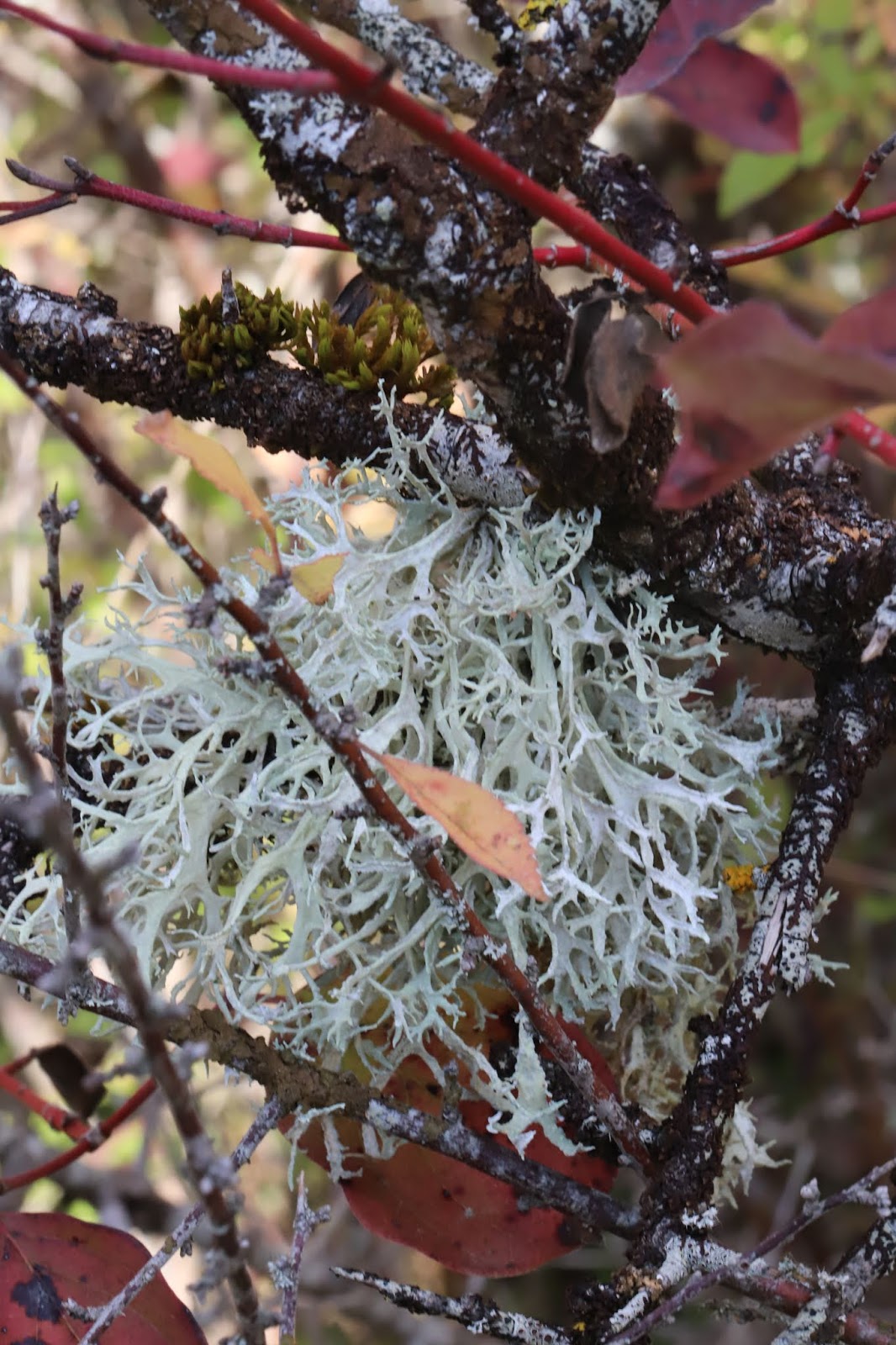
This is not a dusty miller plant, but a macrolichen of the fruticose genre. It is also an epiphyte meaning that it receives nourishment from the air, not the soil. Lichens are fascinating in their complexity, being a mutualistic union between fungus and algae/cyanobacteria. Not only is this specimen not harmful to the tree, it affords protection from wind damage and moisture loss. The colour belies a dry period: In the absence of special pigments, lichens are usually bright green to olive gray when wet, gray or greyish-green to brown when dry. This is because moisture causes the surface skin (cortex) to become more transparent, exposing the green photobiont layer. (Wikipedia)


I decided this was not a speck of glassy trash but instead one of the five-hundred emeralds belonging to the necklace of Girion. I left it there so it can be re-united with the other four-hundred and ninety-nine jewels.


Thoughts changed to a warm lunch and to Zoe the Electric Car which would bring us to that comforting repast as the path widened to a grassy plain topping a windswept hill. 


My camera was secured back into its carrying case, but The Calm One saw this giant, saffron feather duster getting quite a workout by a windy gust so out came the photo equipment.


À la prochaine!

Thursday, 18 October 2018

Southwest France Walks: Angoulême

There is a sizeable green belt within our city. Recently we hiked on a part of it via a trail near Fregeneuil Park, northwest of our home.


I suspect these woody 'ropes' winding up the tree trunk are girdling roots. Generally they are caused if the roots are too deep to get oxygen and water. They don't always cause difficulty for the tree, so let's hope this one will be OK.


A bit further, the path was covered with chestnuts.  Les châtaignes are beloved in French cuisine. Two of my favourites are candied chestnuts and crêpes made from chestnut flour.


Several hollies were thriving in the dappled forest light.


These felled trees probably resulted from a severe storm.


At first I was certain this bush with small, dark-green leaves and plump, round, red berries, belongs either to the cotoneaster or berberis family. After doing some research and flirting with the possibility of cranberry, lingonberry, and chokecherry, I remain stumped. But not discouraged. It took decades for me to identify those 'nests' I kept seeing high in winter trees as mistletoe. I am not giving up with these berries quite as of yet.


Though tramping through a forest is great fun, it's nice to leave its brooding good looks behind for a while to enter a hilltop clearing so you can see clouds puffing over blue skies.


Cattails you say? Yup, cattails! There they were, rustling in the near distance, happily growing in boggy soil, but far from visual reach of my prime macro lens until . . .


. . . a solitary one popped up right on our path's edge. Cattail rhizomes are edible: Evidence of preserved starch grains on grinding stones suggests they were already eaten in Europe 30,000 years ago. (Wikipedia) EDIT: Though there may have been cattails and bulrushes growing together in that patch, the single specimen is a bulrush per this article explaining the differences between the two species.


Towards the end of this walk, a part of the Charente River system made an appearance and so did a swan. Having nature so close to urban development certainly is a positive, but also a chance to see how it suffers due to such proximity. I saw weakened trees, erosion, and significant trash, so much at one point, The Calm One when asked what geographical title I should give this post, he quipped, Trash City.


À la prochaine!

Thursday, 11 October 2018

Southwest France Walks: L'Oisellerie

L'Oisellerie, dating from the 16th century, once a falconry connected with an abbey, and at present, associated with an agricultural school with its own vineyards and wind turbines, is just a ten-minute drive south of us. We tramped across its grounds, past long, low, sealed bags crammed full of composting manure, until we reached our path as forested land with many trails abound nearby. First sight to greet us was a carpet of Virginia creeper.


Forests are splendid for many reasons, and one of the top ones is how they filter sunlight, like highlights on a painting.


At  times the landscape resembles a Chinese ink painting . . .


. . . or a baroque, pastoral scene.


With my imagination, it was easy to think this could be an exposed grave from medieval times instead of the breeze-block deeply ground into the soil that it is.


The artistic perspective suddenly can change to the realistic.


'Tis the season!


Tree trunks, dark and immovable, contribute a brooding kind of charm.


Ah, a rustic fence!


The former falconry itself is where various exhibits for young people, usually comprising scientific (The Calm One contributed to one on computers) or historical content are held. Two staff recognised him, and we were invited to explore the in-progress exhibit/interactive areas and have a nice chat. At present, one room was set up with digital easels and another with the traditional ones. Upon our departure, as we were driving through the grounds, we passed by a group of students who was standing around a vineyard. One young woman excitingly pointed to our electric car and those of the next generation approvingly hailed us.


À la prochaine!

RELATED LINKS

L'Oisellerie
Agricultural school

Thursday, 4 October 2018

What is this?

That's the exact question we asked the seller at one of France's largest annual outdoor flea market located near Marsac, north of our city. He was a shy fellow who gave the barest of smiles while deciding what answer to give. Meanwhile images of braille, telegraph, card hole punching, and IBM Selectric machines all flashed through our visual memories. This jumbled-up melange was halted when he said, it's a typewriter, one without a keyboard, dating from around the start of the previous century.


Such typewriters are referred to as type sleeve or index. Using an image search, we found a German brand, an AEG Mignon, that resembled our fabulous find. At first we were unable to be sure ours was the same model since there were no easily discernible manufacturer's name. Then when The Calm One was sitting nearby it, the light fell just right on the paper holder, like invisible ink suddenly appearing, and we were able to see an embossed, faded, diamond-shaped logo containing the word Heady.


If you want to know about Heady, then you need to know about YuEss. After Germany was vanquished in the First World War, their patents were rendered null and void. In New York City, two Jewish immigrants copied the Mignon, decorated the paper holder with the Star of David, and called their company YuEss (phonetic spelling for U.S.). The machines sold poorly—after all NYC was the powerful domain of Royal Typewriter Company and their splendid keyboard modelsand they moved to France and rebranded their machine Heady. And there, it did reasonably well.


Different typefaces were available via a type sleeve. Though a pointer was needed to be placed on the index card, users matched the speed of keyboard typewriter operators.


I suspect the plastic covering the letters is celluloid. The index card of course needed to be compatible with the particular type sleeve.


Getting it to work is not a total impossibility. The Calm One is hunting high and low for a compatible ribbon which needs to go on the spool in the lower left in the below photo. What would be its first typed word? Typewriter.


A heap of levers cluster to the right of the carriage including a paper bail. I suspect some were used for carrier return spacing.


Though this lever looks like a carriage return lever, it doesn't seem to effect that action.


The left key makes a space (it also allows moving to the left the carriage roller knob to make a carriage return), the middle one strikes the chosen letter, and the right one backspaces.


In a place of honour because so many women were able to improve their lives through typewriting skills, Ms Heady with her pointer positioned smack right on the letter T sits near by my hands rapidly moving over a Macbook Air keyboard and under the watchful eye of the universe in a glass more than eighty years after her manufacture.


À la prochaine!