Thursday, 24 January 2019

Midwinter Garden 2019 Part 2

Just after I sowed a pea bed, frosty winds came bearing down, so before twilight deepened any further, the bed got a cozy horticultural fleece tucked snugly around it. This morning, the cover was stiff with ice. Here's hoping the shallowly planted pea seeds are still viable.


One of the first perennial food crops that gets attention is asparagus. A violet-tinged spear tip here and there means their patch needs some work.


Since the six-year old asparagus planting lustily overgrown its original border of terracotta roofing tiles, the tiles have been removed hence I am in process of digging a trench around the bed, heaping the displaced soil onto the bed itself. Heaped soil is great for asparagus by keeping the bottom of their stalks in the dark, thus blanching them a bit.


Moss fills the space between lichen-covered pavers.


You would be forgiven if you mistook these glorious skeletons of hydrangeas as a flurry of glasswing butterflies.


Lamium galeobdolonone of its several common names is yellow weasel snout (!)has turned its veins burgundy.


A cyclamen unfurls a burst of crimson, laughing at the wind and the cold.


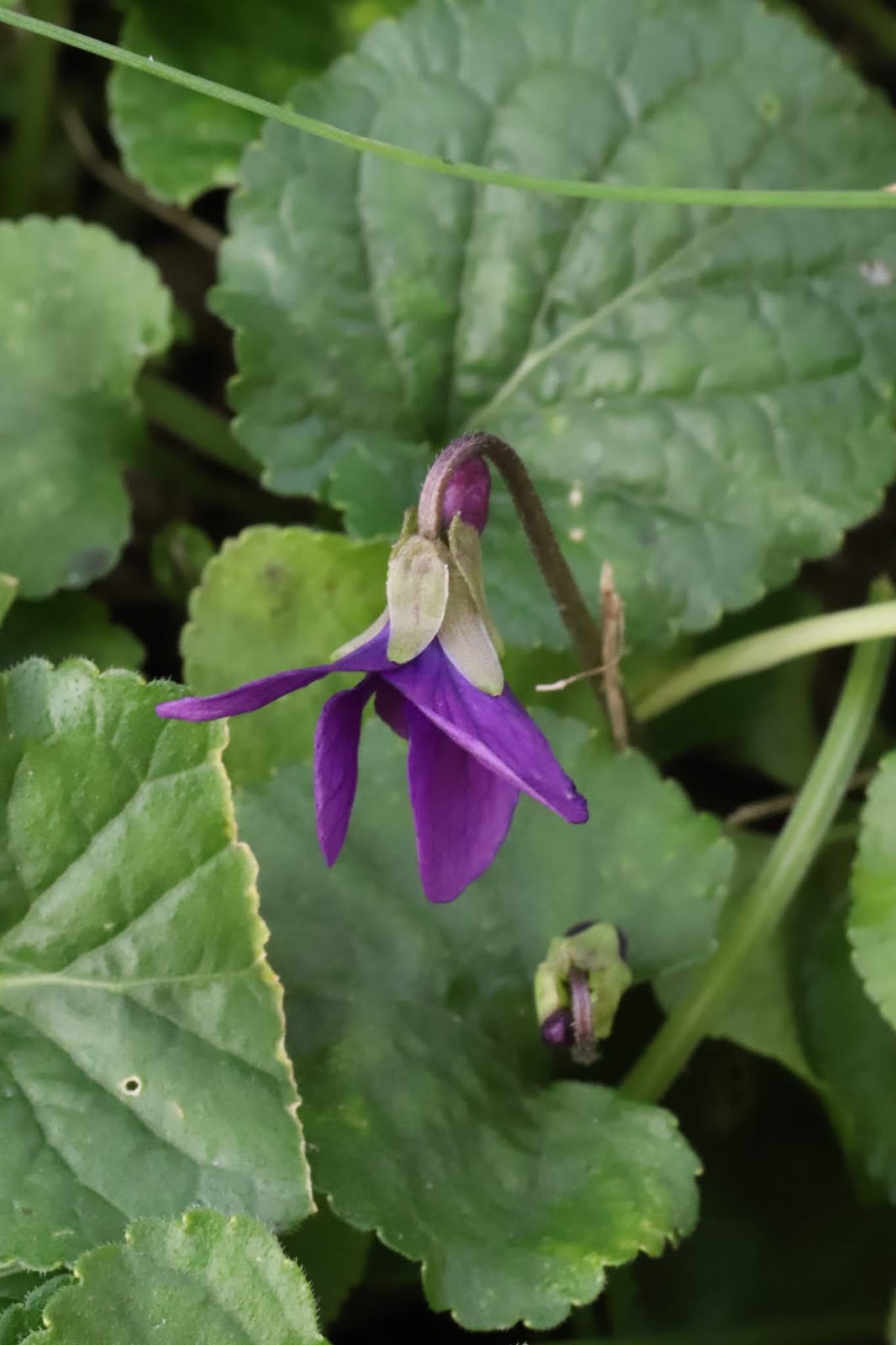
Shade-loving, fragrant sweet violets have spread along the west side of the house forming a carpet because of their powerful way of seed dispersal: their pods snap open, injecting seeds far and wide.


A pop of yellow is always welcome. Thanks, stonecrop!


Each year, I keep adding what is regarded in horticultural jargon as green bones. We talkin' evergreen. One of the older and venerable 'bones' is this yucca which spent the first half of its twenty years in a pot on a Grenoble balcony and the second half in Angoulême soil. It now has several trunks and is close to my height.


À la prochaine!


  • Diana Studer's profile photo
    Will you change from G+ comments on your blog? That is going to sunset too.

    I nurture one pot of violets.
    REPLY
    17h
  • Michelle Beissel's profile photo
    +Diana Studer , if Google allows the maintaining of past comments, then since I hardly get comments outside of G+, I'll opt for the status quo as I really love re-reading old G+ comments when I check past posts (my blog is my recipe book). If not, then all those comments will disappear and that would be sad. Yay for that pot of violets!
    REPLY
    17h
  • Diana Studer's profile photo
    I think the G+ comments will disappear. But there has been NO feedback from Google.
    Maybe edit the comments you value into the text of the blog post? (Which is what I did when I edited posts from my former blog to the current one)
    REPLY
    15h
  • Michelle Beissel's profile photo
    +Diana Studer , excellent idea. Thanks!
    REPLY
    15h
  • Diana Studer's profile photo
    and do it soonish ... they keep jumping the date forward!
    REPLY
    15h
  • Kim Quinn's profile photo
    The hydrangea leaves are so beautiful! I enjoy your posts so much and keep 2 small garden beds, 3x6 and 3x8. They were allowed to rest this past year with a cover crop of hairy vetch, clover, tillage radishes (pods on stems, yummy!) and supposedly field peas. Never saw any of those. It was mixed in April and broadcast over and just whacked 3 or 4 times through the summer when it hit knee height. Now, I am dreaming of herbs, Kale, chard, tomatoes herbsherbsherbs. Wish I had a bona-fide rosemary hedge!💜
    REPLY
    13h
  • Michelle Beissel's profile photo
    +Kim Quinn , thank you so much!

    Your garden interface sounds wonderful (I enjoy whacking cover crops, too). Keep dreaming (and doing). Rosemary is easy to propagate so all you need is a starter plant. If you run out of soil, and you have some cemented area, you can make a potted hedge.
    REPLY

Diana Studer
1 day ago

+
1
0
1
 
Reply

We have a potted hedge on two sides of our kitchen patio. Third side is an in the ground planter (and the fourth is garden) Ours is spekboom Portulacaria afra (which is also edible in salad, a different taste and texture)


Thursday, 17 January 2019

Midwinter Garden 2019

There has been several sunny, not-so-cold days here and there, and when that happens, I am out in the garden cheering on the pallid buds in the daffodil bed. Ten years ago, when arriving at our new home, I began to frame the veggie beds with roofing tiles found heaped in a corner. They have served many a purpose, from preventing our trampling over the planting area, acting as slug/snail traps, allowing the securing of horticultural fleece, and adding a decorative touch.


But they do crack and splinter, needing to be replaced. So out comes the handcart on which the broken tiles get loaded. It is rolled down the garden's length for them to be stacked behind the wildlife area.


Peas need to be planted as early as possible in our climate since it will be too warm for them to flourish by the end of April.  Hence the winter mulch of chipped bark (processed by The Calm One) has been raked to the ends of two beds and the earth spaded. Within a week, the peas will go into the ground and be covered with horticultural fleece which will protect them from freezing temperatures and being eaten by the birds .


Of the fifteen, old fruit trees in less than pristine shape present when we arrived, only a few have survived from being uprooted in storms. One is a purple plum. Another is a peach tree. These two need to be doused with copper (powder mixed with water) each winter twice to prevent leaf curl. The first spraying has been done on a windless, above-freezing-temperature day.


The ivy has set a feast of berries for the birds.


Though I passionately deadhead, I do leave some blossoms to dry on their stems, like this patch of blue asters for their fluffy, white, burst seedpods and as a mulch to protect their roots.


There may be a dearth of colourful flowers, but not of bark, as in this deutzia with its striated tones of apricot and burgundy.


Both the rhubarb and asparagus are putting out buds.


Another flowering plant that escaped my deadheading shears, is a tall sedum (Autumn Joy).


At its base, is a curvaceous cluster of young fleshy leaves.


À la prochaine!

Tuesday, 8 January 2019

Iron Cookware Series: Mashed Potato Cantal Onion Pancakes

Grating raw potatoes for pancakes can be a bother, so how to get that same delectable earthy flavour complete with creamy insides and outside crunch without shredding your fingers in the process? Just ensure that you always make more mashed potatoes than needed. Consider leftover mashed potatoes as having a seat at your table. You are cooking for four? Make believe it is five or six.

Yogurt makes a good accompaniment, both taste and nutrient-wise

When I lived and worked in New York City all those decades ago, a trusty cast-iron skillet had a place of honour on my stove. I loved it so much I use to sneak it into our backpack when we went camping. After yet another move, it got left behind. I have made do with stainless steel frypans with heavy aluminium bottoms. Recently The Calm One ambled into the kitchen with not only a replacement for the cast-iron Dutch Oven which had finally given up the ghost after twenty years of use, but also with a lovely iron skillet with two pouring spouts. The former is a fetching enamelled cherry-red with ivory insides, the latter, equally enamelled, is tomato-red. On to the pancakes! Ingredients (which are in bold) amount just to minced onion, egg, flour, salt, and cheese. I chose Cantal, not my usual entre-deux whose taste is similar to mild cheddar, but Cantal jeune whose flavour is closer to Muenster.


Did I forget an ingredient? Oh, yes, leftover mashed potatoes, of course! The better the mash, the better the pancake. This is how I made mine (choose a variety good for mashing, so no salad potatoes please!): boil peeled potato chunks till tender, strain them, add back to the pot, and dry them out a bit by shaking the pan over a low flame. Put them back in the strainer. While they are being riced, warm milk and butter (about a tablespoon of milk and a teaspoon of butter for each medium potato) in the same pot in which the potatoes were boiled. Add the riced potatoes, beat well with a wooden spoon. Salt to taste. Add more milk and butter if required. Wire-whisk till fluffy. When taking the leftover mashed potatoes out of the fridge, break them up with a wooden spoon to soften them.


For each cup of mash (American cup, 8 fluid oz= 16 tablespoons), make a well, and crack an egg into it.


Beat egg with a fork.


Stir in a tablespoon of minced onion and four heaping tablespoons of grated cheese. Parmesan, gruyere, cheddar, and comte would be nice choices. Add enough flour (I used around four heaping tablespoons) to get the consistency close to the original mashed potatoes, but it will be more moist. Add salt, around one half teaspoon. Cover the bottom of the skillet with oil and heat over medium high for around five minutes. Put heaping tablespoons of the mixture, leaving room between them so they can be smoothed out with the back of a metal spoon dipped in cold water (make sure not to get any water into the hot oil). Lower the flame a bit because iron retains heat well. Brown on one side, around three minutes, flip over, and brown for another three minutes. All the mixture needs to be used because it does not stand well. Drain on paper towels and serve with yogurt. Satisfying and warming on a cold night, they are a treat.


À la prochaine!

RELATED POSTS

Cantal Apple Clafoutis (different cantal affinages are explained)
Cantal Asparagus Tart
Fig Apple Walnut Cantal Dark Rye Hot Open-Faced Sandwich (recipe can be found halfway down the post)

Thursday, 6 December 2018

Thursday, 29 November 2018

Book Review / Against Empathy: The Case For Rational Compassion by Paul Bloom

Mr. Bloom, a Yale Professor of Psychology, isn't exactly against empathy. He is against it being presented ad nauseam as a panacea for all human problems, and because of this myopic viewpoint, better solutions have been relegated to the background. His erudite wrangling with many a fervent opponentthe intellectual equivalent of Houdini wriggling out of chains while underwateris thorough, gracious, and derived from a well-honed perspective which has been worked on since September 11, 2001.

However, is it possible for the offered alternative trio of compassion, self-regulation, and reasoning to reach critical mass as to move humanity in a better direction? Just as empathy, selected by Mr. Bloom from available definitions to signify the ability to feel what others are feeling, can be set at different points on a spectrum because of the varying influence of genes and environment, so can be compassion, self-regulation, and reasoning. Additionally, can these cooler skills override the hyperarousal one of  empathy?

Reasoning is the cornerstone. With that, compassion and self-regulation will tag along. So is reasoning the real deal? While detractors insist on viewing it from a low level of functioning, that is, at the neuronal level and therefore rife with determinism and glitches, he counters with: It turns out that every demonstration of our irrationality is also a demonstration of how smart we are, because without our smarts we wouldn't be able to appreciate that it's a demonstration of irrationality.

Reasoning works to solve problems in your everyday life, not necessarily in a broader sense. For example, you can be irrational at a ballgame, screaming insults at the opposing team, but rational when cooperating with others via carpooling to get home. Also this approach will not result in an utopia where there is no violence, but rather where violence is used sparingly, as in self-defence. But it will give to moral decisions a more fair, just, numerate edge than empathy which is based often on bias.

But what to do with those who don't have much empathy or compassion or reasoning or self regulation? Excluding people who have organic diseases or incapacities, the problem with the rest of this group is that their high-conflict social interactions are egosyntonic, that is, their antagonistic style satisfies the drives of their ego. Compassion, for you and for them, that is, understanding that you must set boundaries on how you are treated and understanding that they are stuck in a non-reciprocal position may just be what the doctor ordered. Experiments showed that when the part of the brain correlated with compassion fires, there is a centred calmness that is present contrasted when the part of the brain correlated with empathy fires. It seems that having a cooler interaction will feel better, therefore setting in motion a climate of deceleration. Mr. Bloom said that one of the reasons why he prefers compassion over empathy is because it doesn't burn you out.

Though the alternatives to empathy are better for creating a more moral universe, we can not live on morality alone. A nice dose of empathy here and there is pretty wonderful.

À la prochaine!

OTHER BOOK REVIEWS

Book Review / The Tulip by Anna Pavord

Book review / The Asshole Survival Guide: How to Deal with People Who Treat You Like Dirt by Robert I. Sutton

Book Review / Florike Egmond's An Eye For Detail: Images of Plants and Animals in Art and Science, 1500-1630

Book Review / Hot Bread Kitchen Cookbook: Artisanal

Baking From Around The World by Jessamyn Waldman

Rodriguez with Julia Turshen


Book Review/The Confidence Game: The Psychology Of The Con And Why We Fall For It Every Time By Maria Konnikova


Book Review / The Faith of a Writer: Life, Craft, Art by Joyce Carol Oates


EXTERNAL LINKS

Paul Bloom at Twitter

Against Empathy at Amazon

Paul Bloom's Introduction To Psychology at Coursera (Starts Nov. 29, 2018)

Paul Bloom's Moralities Of Everyday Life at Coursera (Starts Nov. 29, 2018)

Thursday, 22 November 2018

Southwest France Walks: Mouthiers Part 2

During a past walk done near Mouthiers, we noted a small cave in the forest flanking our trail. Time restraints prevented exploring it. We, with feet outfitted in new hiking shoes, returned to take on the muddy challenge as there had been several days of rain.


The Calm One's trusty, hand-whittled walking stick got us up the slippery incline.


The interior was the size of a cozy studio, a studio equipped with vaulted ceiling and view.


The stony shelter had tiny openings that let in shafts of light.


As this graffiti seem birdlike and contained colours similar to prehistoric cave paintings, I would like to think that the artist wanted to make a visual connection to what went before.


We scrambled back down onto the trail. The ambiance was somewhat gloomy as everything was muddied. A golden leaf appeared in front of my feet bringing a smile to my face. Then I noticed leaves fluttering down all over. A rustling sound became background music.


Here's the fabled walking stick, smooth and slick. Though this little, white-stemmed, brown-capped mushroom sprouted right on the path, it somehow managed to evade being stomped into oblivion.


I enjoy noting watering holes for wildlife. This choice one is a rotted tree trunk filled with rain water.


We took a wrong turn and wound up in less-trampled terrain. We got a bit scratched and whacked with low-lying branches. But we persisted and got back on the proper path. Before doing so, I was able to get this shot of two different berries, one black, the other red, because this entwined display smacked me in the face.


I find signs of decay in nature thrilling. This fallen tree's moss-covered bark is peeling off in great circular pieces. This cycle of death and renewal has been going on way before our species evolved.


À la prochaine!

Thursday, 15 November 2018

Mid-Autumn Garden 2018

November has its particular gardening tasks. I sat under the ivy-covered pergola thinking, oh my goodness, I haven't transplanted the recently arrived nursery shipment. Up I go.

Inspiring perspective offered by my humble lounge chair

Getting lots of small-sized shrubs sent allows a great choice and lower prices than can be found at neighbourhood gardening centres. Doing this in the autumn is my preference ever since a Yorkshire nurseryman informed me a few decades ago that the selection available is less pot-bound than what can be bought in the spring since whatever doesn't sell sits through winter until when purchasing pick up again as the weather becomes mild enough. Eight Japanese holly, six ball-shaped, two conical, got their own bed and were  mulched. The focus is to get transplants done several weeks before the first frost to encourage root development. Because box plants have become susceptible to disease, Japanese holly, with their small, dark-green and permanent foliage, have become one of the most favourite substitutes to create precisely clipped shapes and topiary.


Back under the pergola I go! Looking at the 'Sky Rocket' juniper which when transplanted from its nursery bed this past February at the tender height of 30 cm, I noted its height now is closer to 90 cm. Encouraged by the fruits of my past labour, I get up . . .


. . . to position 100 daffodil bulbs. This bounty came from just fifteen ones that were planted about eight years ago. That small patch stopped blooming last spring as is the way of overcrowded daffodils. So I dug them up and was delighted to see how much they propagated. Once they were placed on the prepared bed, the length of a hand trowel was driven into the soil, shifted to one side, and the bulb dropped down around 15 cm deep. After they all got done, the surface was patted down with the flat side of a spade. Around February, this centre bed will be aglow with golden blooms.

The leafy bed behind the daffodils is filled with tansy, a cover crop, that soon will be mowed down so as to mulch the soil through winter

One of the projects completed this summerone that I wanted to do years agowas putting plastic (a large potting mix bag cut open) over a dodgy former drain, circle it with roofing tiles, thickly layering wood chips (diligently chipped by The Calm One via our new chipping machine), and placing on top pots of shade-loving plants like heuchera and ferns as this area is situated under box elder and cherry plum trees.


After years, the ivy has taken hold and covers much of our east-facing property wall. It is a major beautifier. It need about 2-4 trims yearly so it will become a bush-like growth up to 180 cm beyond the top of the wall. When ivy runs out of vertical support, it becomes bushy and laden with berries which are wonderful winter bird food.


The narrow iris bed flanking the central path will be replaced with a selection of plants that will look good all year round and not just during May. Some of the candidates are Japanese holly, moss pink, heather, perennials like penstemon, and long-blooming annuals like asters and cosmos.

Mound of leaves covered with netting in the background will become mulch by spring

This critter with the delicately pink nose is Eli the Cat.  He found a bag full of leaves to be exceedingly comfy. . .


. . . while Dirac the Cat chose a sunny sous-sol window sill.


À la prochaine!