Thursday, 19 March 2020

Gardening In The Time Of Covid-19*

I have felt a deep affection for our garden during the past ten years, so it's challenging to express how much more I presently love it as France completes its third day of lockdown while spring makes its much awaited appearence.

Foreground: off the patio white sweet alyssum, red tulip, abelia, irises, ivy-covered pergola pillar; background: lawn and that wide, brown smear is the asparagus bed.

Our larder and freezer is well stocked allowing us to refrain from food shopping (which is permitted but only if carrying a self-signed certificate printed from the government's website) which is mutually beneficial for us and others. But fresh can't be beat and the seven-year-old asparagus bed has begun in earnest last week popping out spears. Though their delectable taste lessens each day of storage, cutting off the woody ends (trimmings can be used for making stock), placing the asparagus upright in a jar with 2.5 cm (an inch) of water, and covering with a plastic bag keeps their flavour longer. In this way enough can be harvested to make a soup.


Rhubarb will soon be on its way.


In about a week, pea shoots will be ready for picking. Ah, fresh greens!


In about two months, raspberries born on last season's canes will be ripe. Once harvested, those canes will be cut almost to the ground, and new ones will grow enabling a second crop for September.


Strawberries will be ready by beginning of May.


I haven't planted any new tulips last autumn and hope what is in the ground will do their thing soon. Presently, there are single show stoppers like an Apeldoorn Darwin Hybrid bud peeking out in between an ivy-covered fence and a Leyland cypress hedge . . .


. . . and this sprightly Seadov Triumph tulip sprouting on the compost under a rusty pole . . .


. . . and finally this Purple Dream lily-flowered tulip gracing the front garden.


A sizable expanse of low-growing, evergreen periwinkle (Vinca minor) just off the front entrance staircase is full of their lovely blue blooms. 


À la prochaine!

* Yes, Love In The Time Of Cholera by Márquez inspired my post title!

RELATED POSTS

How To Plant Asparagus


Asparagus Soup and Green Onion Soup

Cantal Asparagus Tart with Creme Fraiche

Baked Parmesan Asparagus Polenta Sausage Frittata


Thursday, 12 March 2020

Thursday, 5 March 2020

Winter Garden Flowers & Café Au Lait

Our urban garden with its golden bed of wind-swept daffodils was strongly blurred behind fogged, rain-splattered kitchen windows this stormy morn.


It's fairly gloomy and has been for months. To cheer myself up I went into my office and peeked out of that window since it's partially protected from rain by a shutter positioned in awning mode, and lo and behold, daffodils in all their bright splendour!


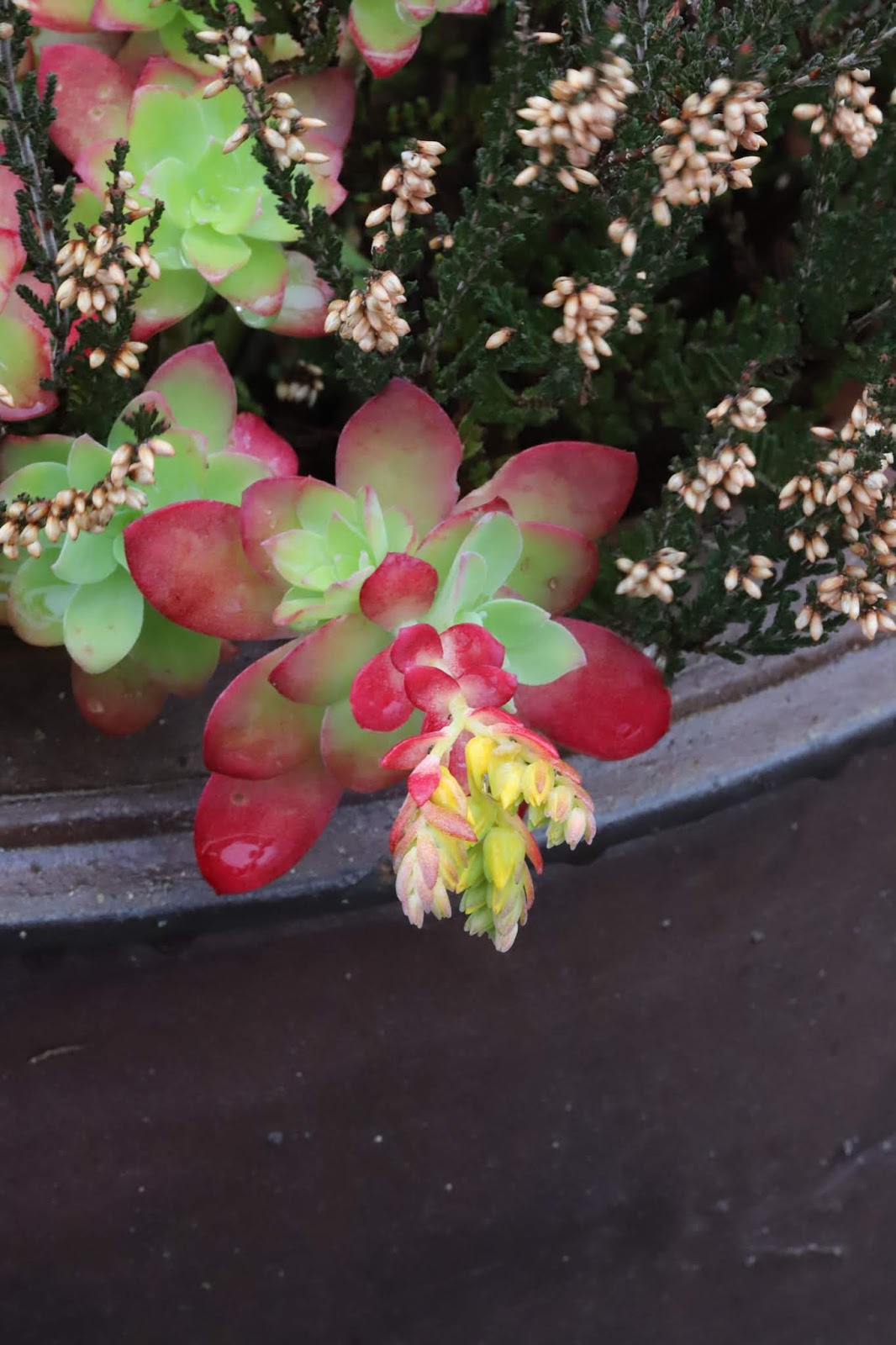
I then realised Eli the Cat was out and about. When I went to fetch him I took my camera because the other day I had noted the luscious burgundy staining the potted sedum's outer leaves . . .


. . .  not to mention their yellow blooms. Its companion, late-summer-blooming pink heather has long since faded to white, but its dark green, needlelike leaves adds a nice contrast to the front garden display.


Upon our return, before I warmed up and cosily steamed up the kitchen at the same time by making café au lait, I towelled off the very wet Eli the Cat, including his pawsDrying him off is not only good for keeping Eli in good nick and not having mud tracked throughout, but also cats get upset when they smell their own fur, which they do when wetly odoriferous, because if they can, other animals not as friendly as moi can too. 

(Ingredients are in bold.) Café au lait is a lovely, lovely, lovely hot drink with a smooth but slightly airy texture. Though fairly simple needing no special machine, it's not just a coffee diluted with lots of milk as its strong taste is still present, but a bit more mellow. It's made by pouring separately and simultaneously one thirds hot, strong coffee, that is, a lot of coffee in proportion to water (I used three heaping teaspoons of freeze-dried coffee for 118 ml/4 oz hot water) and two thirds hot, whole milk (237 ml/8 oz) into a bowl specially made for cupping both hands around the warming surface while they are supported by a sturdy foot. In this sensual manner, the bracing and nourishing beverage is slowly sipped. A spare café au lait bowl can be used to measure roughly separate amounts of coffee and milk before heating them either on a stove or in the microwave in their own pots/containers. The higher the milk and coffee is poured, the more creamy it will be. The Calm One assisted by doing the pouring which was made easier by having the liquids in small pitchers. Alternatively the coffee and milk could be heated together, shaken in a lidded jar for about a minute, and poured into the bowl. It still won't be as foamy as a latte, because after all it is a café au lait.


Often presented as a morning meal, a bowl of café au lait is served with tartines which are slices of bread, either toasted or not, and spread with good things, like butter and jam or if something fancier is desired, with viennoiseries rich in butter, sugar, eggs, like chausson au pommes (literal translation: apple slippers, that is, apple turnovers), pain au chocolate, pain aux raisins, croissant aux amandes, and brioche. Young children usually have bowls of hot chocolate instead of coffee. In my case, I grated some dark chocolate over mine. Freshly grated nutmeg or a mint sprig would be nice touches instead. If I remembered to take out from the freezer the remaining blueberry muffin made with our own berries from last season, I would have toasted and buttered it. I promise you and me in the very near future this will be the case.


À la prochaine!

Thursday, 27 February 2020

Photography Series: Winter I

I love the Canon EOS 6D Mark II camera along with a macro 100mm lens that I got two winters ago during the holiday season of 2017. Since it is a complicated bit of equipment, and I wanted to use it as quickly as possible, that is, not in its fully manual mode, nor in its completely automated and unchallenging role, I went for partial automation, to be precise, I chose aperture priority mode, meaning, I get to choose how wide the lens is positioned, while the camera does everything else. En bref, on my camera the lowest f-stop of 2.8 denotes the widest lens opening letting in the most light but providing the least depth of field. It is fantastic for producing the desirable bokeh effect where the background is gorgeously diffused.


Rain on windowpane

Rose of Sharon's burst seed pod

Fluffy aster seed pods

Rose thorn

Red berry on an aucuba

For a mixed depth of field, where the whitish rock is in the sharpest focus, the broken terracotta roofing tiles are less, and the cement background blurred, I chose f/16.


For the fullest depth of field and also to cut down on glare contributed by city lights, I picked the highest, that is,  f/32.


Factory chimney bathed in the light of the crescent moon? No, it has floodlights on it!

To get decent depth of field for this shot of frozen birdbath water dumped onto the grass, I also selected f/32 while being straddled over the subjects.


Knowing I wanted to let in as much light without sacrificing the frosty details of these penstemons, I picked f/9.


For these unfurling rhubarb buds, as light was less of a problem and I wanted to get as many closeup details as possible without losing the bokeh effect, I dialed to f/20.


I am looking forward to using more and more features on this beauty of a camera. But in general, I keep my photography simple, practical, and fun. The photos also inspire my coloured pencil artwork. I have taken a couple of Coursera classes which I recommend:

Seeing Through Photography

Photography Basics and Beyond (I just audited it for no cost)

À la prochaine!

Thursday, 20 February 2020

Late Winter Garden Doings 2020

The last several weeks chez nous have been marked with increasing activity in the garden. Spades, small and large, pruning saws, a grass-cutting line trimmer, a compost-turning fork, and more are scattered here and there throughout the garden. When locking up for the nightoccurring later and later each timethe order of the day is retrieving all those tools and securing them in the mudroom. The centre bed was planted two autumns ago with daffodil bulbs generously donated by a small, crowded, ten-old patch. Last spring, it sported lots of foliage, but just five flowers! The leaves were allowed to wilt completely, nourishing the bulbs therefore giving forth a prominent splash of the brightest yellow this spring. The spade below is for working the second of three to-be-pea beds. Peas need the soil to be around 4.5 degrees C/40 degrees F, so cool, not cold, but neither warm. Being without a soil thermometer, I instead flipped over a deep clod of earth and touched it. Not yet ready for planting peas. Probably within the week. Otherwise, they will sit and sulk in the wet soil, encouraging rotting. Another sign that sowing is around the corner are the sedges of cranes flying up from North Africa beginning last week.


I looked at those cheery trumpets and thought flower bouquet! And I did need a break. So out came the secateurs. First, several daffodils were cut. Then some heather.


Also a bunch of sweet violets. I needed to reach below the lusty foliage to get at the beauties as they grow up from the plant's base.


They all went in the flower brick on the mantlepiece.


Ah, the FRESH perfume of just cut flowers!


As I was fertilising the asparagus bed, I noticed a volunteer bay laurel seedling. Bay laurels are versatile, hence think of a place for them in your garden, whether as a potted herb or a hedge or a small tree. And what a gorgeous fragrance when clipped! It makes you want to run into the house and cook up a stew. I use them in all three ways, and plus, they are evergreen, wonderful for blocking out whatever needs to be. A pot was filled with potting mix, well watered, and the seedling transplanted. It will remain out of the sun under the pergola, wrapped in its own plastic-bag 'greenhouse' until its roots adapt. Right now it has to rely on its leaves to absorb moisture.


An acquaintance of The Calm One gave us lots of mini-roses. About twenty in total. I gave them a light pruning, will spray against disease like blackspot/mildew and fertilise in the near future. They will remain in their pots this season. Once I see what colour the roses have, I'll decide on their permanent locations, whether in the ground or in planters.


There are two Juniper 'Skyrockets' whose height match my own flanking a laurel hedge on the garden's west side. A month ago or so, strong winds loosened one of them, causing it to list to one side. It was the one with the widest branches so I pruned it a bit to make it as slim as its partner, and then I circled both with paving stones to provide support. So far, so good.


I love compost especially the stuff I make myself which smells like the way it looks, luscious, aerated, and nourishing. There's a nice mound that has overwintered and waiting for a good sieving. Some of it will be forked into the three beds slated for pea sowing.


These seed potatoes are red-skinned, yellow-fleshed, all-purpose, midseason 'Rosabelle' from the local garden centre and are certified disease free. They require several weeks of sitting in old egg cartons on a sunny windowsill so they can grow sprouts a 2.5 cm/an inch or so tall. These have about two more weeks to go. This growth is different from the long, white strands poking out of poorly stored potatoes. These are stubby and coloured from lavender to green or a mix. They essentially are the stems that will grow eventually above the soil, leaving the attached and developing potatoes underground until ready to dig up.


À la prochaine!

Thursday, 13 February 2020

Artwork Series: Learning From Lautrec

My appreciating how wonderful, gorgeous, and evocative Toulouse-Lautrec's artistic expression is does not completely inspire me, because at times his art lends a discouraging perspective giving forth to the nagging, internal question, why bother? My work has so much less quality and oomph. But there's opportunity as precious as his talent, a chance to learn, to improve, and perhaps advance to my own level of excellence. Two of his works, At the Moulin-Rouge: Goulue and her sister (1892) and The Toilette/The Redhead (1889), are the ones that I have interpreted recently. His medium was colour lithography for the former/oil paint on cardboard for the latter; my renditions were done with colour pencils (the very excellent Faber-Castell polychromos) on inexpensive paper. Such paper is good for everyday practicing though I do use high-quality paper for original work. As seen in the below photo, Lautrec is masterful in making one person's positive feature someone else's negative space as in the background's gentleman directly to Goulue's left whose black attire shapes Goulue's shrugging left shoulder. Another example of his wondrous manipulation of space is the shaping of Goulue's shrugging right shoulder is accomplished by the nose of the man directly to her right! This visual cleverness would have been wasted on me if I had not drawn my version.

Lautrec's lithograph: the woman on Goulue's right wasn't her sister, but a can-can dancing colleague,  Môme Fromage (translation: cheese-loving kid!)

I chose to make my version larger though it is challenging to increase the scale while trying to capture proportions among the elements in the picture plane, because it is also a way to push my development by making my drawing more difficult to do.


His of course has the characteristics of a lithography, smooth texture with sharply outlined forms, mine has patchy colour and softer delineations. (Lautrec's is on the left, mine on the right.)


The aspect that drew me to this lithography was the staggering insouciance of Goulue's posture as if there was no one else important but her in the room. Various aspects contribute to her lack of interest in others such as her tilt of chin, her hand defiantly planted on her hip, and her shrug emanating such disdain that it comes as close to a physical slap in your face without being carnally combative. That shrug was not captured perfectly by me, but it came close enough. (Lautrec's is on the left, mine on right.)


The second work, The Toilette/The Redhead, is nothing short of magnificent. I love the colours he used, among others, the blues both warm and cool; I love the rumpled fabric of her clothes and background draperies; I love her hair, especially her slightly unraveling chignon; I love the helter-skelter placement of all the components, from her slightly forward leaning torso to the chair, table, and bathtub; I love that the light is coming from behind her.


My version below got some of the aspects that I found alluring.


Her figure was much more forward leaning because I deviated from the plumbline that I had drawn down her centre. Her lower leg, clothed in a stocking, was less foreshortened. (His is on the left, mine on the right)


My incising the floor area under the chair with a rounded tool before I did any colouring resisted any pigment therefore giving the impression of floor boards. Same technique was used for highlights in her hair.


His (the below left photo) had less pronounced floor boards and a hair bun proportionally smaller than mine (on the right).


Lautrec is an excellent teacher and I am a half-way decent student!

À la prochaine!

RELATED POST

Artwork Series: Faber-Castell Polychromos Pencil Drawing of Two Desert Roses

Thursday, 6 February 2020

Raspberry Jam Love Notes

These delectable love-note pastries, not only suitable for Valentine's, but also for snacks, desserts, and breakfasts, are simple to make. At first try, the notes most likely won't be perfectly sealed and presented, mine certainly weren't, but they look adorable enough. Since I always freeze pastry scraps left from making pies, I just had to defrost my home-made dough. Good quality from the shops would work fine also.


Ingredients
Adapted from Delish (video)
makes four pastries, recipe can be doubled
  • Shortcrust pastry, 1 crust, store-bought or homemade
  • Jam, raspberry or strawberry, heaping teaspoon for each note
  • Sugar to sprinkle
  • Egg wash (one egg beaten well)
  • Flour for dusting

Preheat oven to 190 degrees C/375 degrees F. Lightly flour your surface and roll out the pastry. Thinner means neater love notes since they will puff up less than thicker pastry. In any case, we are talking a range of .32 -.64 cm (1/8-1/4 inch). The notes regardless can be pricked all over with the tines of  a fork before placing in the oven to discourage the formation of bubbles. As a template to cut pastry squares, I used a plastic container's 10 cm/4 inch lid.


Position each square as to present a diamond shape. Place jam in centre. Less jam means more behaved notes. More jam is tastier but also results in messier notes. I went for more jam and I don't regret it. Fold the lateral points towards the centre, without overlapping too much.


Fold the bottom point towards the other two points. Seal with a heart. Lightly press down to ensure contact among the various overlapping layers of pastry. Coat with egg wash and sprinkle with sugar. Again if presentation is important to you, then brushing the edges of the pastry which touch each other with egg wash will assist in their remaining closed while being baked.


To make hearts, I folded small squares of pastry and traced with a knife without slicing through the fold, a half of a heart. I carefully cut around that half, then . . .


. . . opened the square and removed the heart.


Bake for fifteen minutes on a lined baking sheet.


They taste wonderful with coffee, tea, or milk. Served warm or cold, they are delicious. They freeze well also. I now know what the next batch of pastry scraps will be used for!


À la prochaine!