Saturday, 7 July 2012

Off to Hyères and Nice!

The Calm One needed to spend five days in Provence with a client so I got to tag along as the photo journalist.  We started our all-day journey by leaving Angouleme early and catching a train to Bordeaux and then to Marseille where we got our final connection to Hyères, our destination.

I find analog clocks comforting, and the Bordeaux station had a lovely one

Set in the middle of the busy Bordeaux station,  this burgundy-coloured pastry wagon was filled with a pastry called CaneléHowever, I was able to refrain from eating this regional speciality with its tender, custard-like innards encased in a thin, deeply carmelized, delicately fluted crust. I had a feeling that I needed to ration the amount of rich pastries I would be consuming on this trip so this was way too early to start stuffing my face.


Hyères dates back to Greek settlement.  Initially it was right on the sea, but as pirates became a problem, the city moved inland a bit, on an elevated spot where a series of expanding walled circles were built.  As it grew, eventually construction expanded into the surrounding hills and valleys, outside the original walled gates.

A narrow street within the walled old quartier with a black cat on the left

Bougainvillea, colourful shutters, and cobblestones

A smart choice of a pale, grey-blue, hanging succulent in a window  box

In the mid 1800's, some movers and shakers decided to plant palm trees in the areas expanding outwards from the old city.  Hyères then became popular with the hivernants--visitors escaping from winter in their own countries--especially the English following Queen Victoria's stay.


The smaller palmier has a trunk resembling a pineapple

Les Palmiers are everywhere.  Instead of some floppy, wind-torn petunias in a roundabout, there are various stout palm trees.

A roundabout planting of palm trees

Oleanders of various hues

Dating from the late 1800s, this fountain was built and named for a rich industrialist, Godillot, who was instrumental in modernising Hyères.  Old photos showed that at the time this location was practically rural, while presently I had to wait some time for traffic to cease at this busy roundabout in order to get a clean shot.

The four statues represent mythological figures.

There are several old churches.  The one nearby where we stayed tolled each hour of the day twice--the first ringing done on the hour and the second five minutes later so one can check the number of peals--with a solitary one marking each half an hour.  One of the oldest churches is from the 1200s.

Thirteenth century St. Louis with its three front doors representing the trinity

The Calm One's client graciously let us stay at his home which is located in the old town.  Off a single lane street, one enters an even narrower street pictured below.

The first turn off on the left is a narrow passageway leading to where we stayed

We stayed in the end house on the left in the photo below, behind the yellow door. After the green door there is an even narrower path on the right leading to another house.  Often sheltered between the two, opened outer-doors was Caroline, a very sweet, light-orange, long-haired cat with one eye. She lost half her vision in a fight with a bird.  I am guessing if she could talk, she would say, you should see the other guy.


I had chosen the very best garlic from my harvest to give to the lady of the house.  She hung the braid of garlic in a well ventilated place and out of the sun.

That's the garlic I have grown in my potager!

Their house is a narrow one with its five levels connected via a winding staircase.  The last flight of stairs is exceedingly narrow leading onto the roof's patio.

The skylight is composed of curved, transparent roof tiles

There usually was a refreshing breeze up on the roof patio which was very welcomed because it can get quite hot in this area.

We enjoyed some wonderful meals (and pastries!) on the roof patio

On our first night here, our host led us up rather steep paths into the old fortress area high up on the hills while describing the history of his town.  With a fast deepening twilight and chirping crickets all around us, the descent was a bit exciting, and I probably would not have made it down in one piece if not for the scrupulous attention of the Calm One.  I am grateful to both men for a memorable time.

Some of the lower ruins of the old fortress area

I found the very densely situated houses in the old quarter to give a dreamy quality to every day life--I would be walking up/down the various flights of stairs, hearing bits of conversations from other households drifting through our cracked-open shutters: a mother saying A table! to summon her family to dinner, a neighbour singing with joy as he does a spot of gardening in his tiny garden,  the clinking of plates and glasses, assorted coughs and sneezes, and of course, the almost constant ringing of church bells. It was not exactly intrusive--everything  is shuttered, muffled though thick stone walls, presenting a living collage with others' routines layered over yours.

We visited Nice, which was about an hour's drive east of Hyères to check out a history of video game exhibition and to eat socca, a regional speciality.  I could show the many photos I took of various games, keyboards, and explanatory panels, but I think the photo below was the most visually arresting.

Skulls wreathed in smoke sharing wall space with some casual photos

We then strolled through Nice. As we ambled around a square, I realised that the rather elegant yellow buildings did not really have ornate cornices and balconies as they were all trompe d'oeils.  They are excellent, down to the detail of the shadow that real cornices would have cast.


The right side of the yellow building has no trompe d'oeils

Those are not real balconies and cornices!

Close by to this square is a long pedestrian street filled with interesting boutiques and restaurants.


In this area close to Italy, signs are often bi-lingual

Gourmet salts are a big thing here and this shop does not disappoint with its selection including one mixed with green tea.


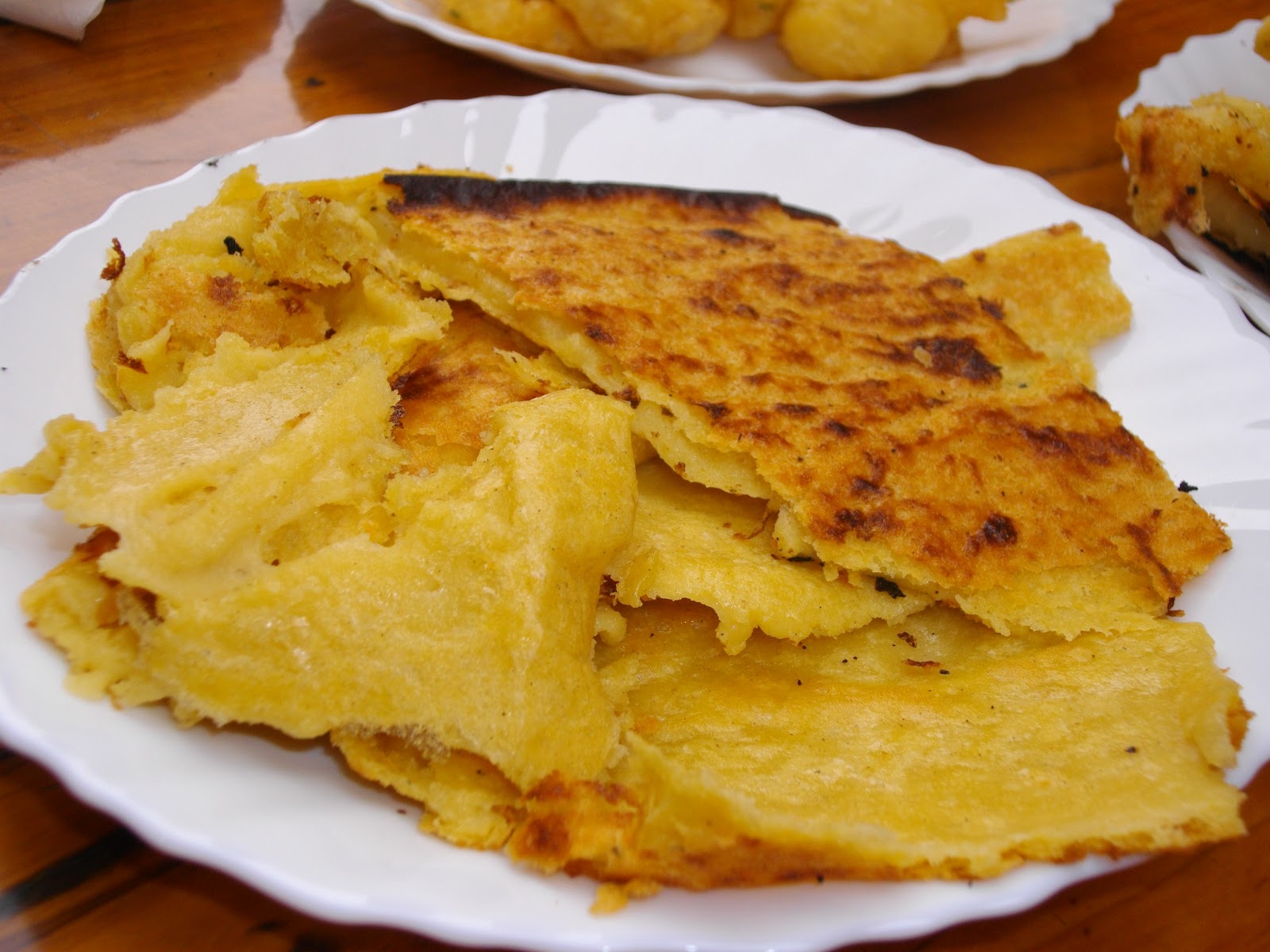
It was time for lunch, and I was finally able to sample socca which is made from chick pea flour and grilled over a wood fire in big, round batches.  Your serving consists of pieces from this large circle. It is kind of a French version of refried beans, and I really liked it--creamy but crusty, tasty, and nourishing.


Interestingly, our host never heard of socca.  His verdict?  Good enough to eat every once in a while, but it would be much better if it had toppings like cheese, etc. 

Besides a plethora of churches, fountains, there are many wonderful towers with clocks.


Eventually, we walked to the Mediterranean and the plage.


The beautiful azure of the Mediterranean sea

Though I had a great time, it was so nice to get back to the potager and Monsieur and Madame M who kept a watchful eye over Dayo the cat and the garden.


Wednesday, 4 July 2012

Kitchen Sink Potato Salad

Our summer continues to be surprisingly gentle with reasonable temperatures and moderate rain.  The hydrangea is blooming the first time in three years because previous summers were just too blistering hot and mercilessly dry.  The poor hydrangea had looked as if a plant-hating arsonist took a torch to it.   Though still on the smallish size, it looks triumphantly beautiful in my eyes.

A deep-pink Hydrangea and lavender fronting Spiraea and Weigela bushes

Green beans are just beginning to come in.


As are the raspberries.


I fondly refer to this recipe as kitchen sink potato salad as it contains just about everything:  meat, fish, fruit, and vegetables.   The French would more elegantly label it as a macédoine.  A grand recipe of the Calm One's paternal family, it is a dish that it seems you either love or hate or at the very least, leave out the pickled herring.  Traditionally, this salad of Polish origin, is made for Christmas Eve.  I encountered a version of it quite a long time ago because it was presented as a festive holiday recipe in The Vegetarian Epicure, a lovely cook book I was quite smitten with at that timeI remember fancifully decorating it with a large Pointsettia made from red and green bell peppers, pearl onions, and small black olives.  Since the Calm One's paternal family were Germans living in Poland, I suspect they added their own touches.

However, the Calm One makes it whenever I am so busy weeding, digging, transplanting, watering, mulching, composting, harvesting, preserving, taking photos, blogging, and stock trading that cooking is the last thing on my mind.  We eat it straight for four days; all we do is plop a delicious mound of this salad on our plates.  He makes it so well that I just stare at his doing it with amazement.  It is not hard, but it does take focus, effort, and planning. 


The family secret is cleverly cubing the potatoes with an egg slicer.  The end result is tiny, firm bits of intense flavour as this method increases the surface area available for marination. The Calm One does not measure his ingredients so when I asked what would be a good rule of thumb to follow regarding proportions, he replied, well, ten hard-boiled eggs to one potato would not be a good one. He did say that the salad would taste fine if there is one more egg or one less potato.  When pressed further, he said, count the ingredients in the photos.  Equipped with that advice, I will do my best to approximate quantities used.  An important guiding principle of his is focusing on the consistency which needs to be very moist but creamy and not runny at all.


Ingredients

  • Potatoes, ten medium all-purpose potatoes
  • Eggs, ten medium, hard boiled
  • Salami, I prefer Italian; he Danish, ten slices
  • Dill pickles/cornichons, six small and their liquid, 1/2 cup
  • Pickled herring, one large fillet, skinned
  • Tart apples, two large, preferably Granny Smith
  • Mayonnaise, 700 grams, nearly 3 cups
  • Salt and freshly ground pepper to taste

Equipment

Egg slicer
Pots
Large bowl
Knives 
Chopping board
Wooden spoons

Instructions 
(Makes enough for 4 main meals for two adults, that is, a whopping big quantity)

Request the Calm One's appearance chez vous...only kidding, here they are:

The day before serving the salad

1)  Hard boil the eggs, cool, and peel.
2)  Cook the potatoes in their jacket, cool and peel
3)  Put the cooked eggs and potatoes, covered, in the fridge

Later in the day:

1)  Using an egg slicer, cube both the eggs and potatoes.  If potatoes are much larger than an egg, halve them.

First slicing
Second slicing:  flip over so its slices are positioned bottom to top

Completion of the second slicing

3rd slicing:  position its length across the slicer with the most recent slices arranged from top to bottom

Cubed!

2) Put cubed eggs and potatoes into a large bowl

3)  Chop finely the salami, herring, cornichons, and apples.  Add to bowl.


 4)  Stir well, add Mayo and stir again until well mixed.


5)  Strain the pickle juice into the mayo jar.


6) Put lid back on jar and shake well, then pour into the bowl.  The Calm One never tastes the salad while making or seasoning it as he says that any taste test would not be accurate as it would not take into account the overnight marination, and yet the flavour is always just right.  Being the rebel that I am, I say, go ahead and season to taste, keeping in mind that it will deepen in flavour but not necessarily get saltier.


7)  Mix gently but well and let marinate overnight covered in the fridge for serving next day.


The salad goes nicely with hot saucisses de Strausbourg (frankfurters/hot dogs are similar) and Dijon mustard.


As potatoes do not freeze well, I am afraid all of it will have to be eaten within four days.  Somehow, I think most will be up to that challenge.

Bon appétit!

RELATED POSTS

Sowing potatoes
Hilling and side dressing potato plants
 

Tuesday, 26 June 2012

Potatoes and Tomatoes: Continuing Early Summer Care

This summer with temperatures in the mid and upper eighties and lots of rain has been kind to gardeners in our area.   Lilies are so fragrant that it takes just one bloom to perfume my potting room and keep me happy as I prepare flats of broccoli and Brussels sprouts for an autumnal harvest.


The English lavender is in full bloom while the taller and lighted-coloured French lavender is just starting.  Most of our lavender is in our front garden.  I love when I see passersby catching a whiff and walking away smiling.  Lavender has a very fresh and uplifting fragrance.


I use lavender as a culinary herb and for making lavender water.  I pick the freshest flowers for kitchen use, just a few buds, before they open.  Supposedly English lavender is better for culinary and cosmetic use, but I can't tell the difference.  Lavender goes well with roast chicken and in creamy salad dressings as long as you go very easy on the quantity or else your dish will taste like perfume.  Some prefer to grind the buds for a powdery texture.  Picking off the buds in ample amounts for lavender water is tedious though, but then again, the fragrance surrounding you helps you keep at it.

When making lavender water, I add boiling water just enough to cover fresh buds and let steep until cool, making sure I squeeze the flowers as dry as I can to extract their fragrance.  Just as with rosewater, I freeze the strained lavender water in ice cube trays, taking what I need for the bath as required.  When dried--I spread the buds on trays--lavender is perfect for linen closet sachets and in potpourris.

The tomatoes are doing well despite a delayed planting because of cold temperatures in late spring.

Early season Marmande tomatoes

I grow both interminate and determinate tomatoes.  The former bear fruit throughout the season and seem to do best when they are pruned and staked.  The later kind fruits all at once and are fine without pruning or staking and are a boon when you just have run out of time for yet some more pruning and staking.  I scratch in a high potassium fertilizer--NPK formula with a high last number-- for both kinds when flowers appear.  Mulching deeply cuts down on both watering and weeding.  We are allowed by city edict only to water our gardens early in the morning or late at night as those times are best to lessen wasteful evaporation.

Staked indeterminate varieties:  Beefmaster and Marmande

In the foreground are bushy plum-shaped Romas, a great sauce tomato

Pruning the indeterminate type means pinching off the little branch that grows in the crotch of two larger branches.  Ideally, you want just one leading/head branch twirling around the tuteur.


As for the potatoes, when plants are about eight inches high, it is necessary to side dress with a high phosphorus fertilizer--NPK formula with a high middle number--and hill them.  This mounding prevents any potato close to the surface turning green from sunlight exposure.


The seed packet shows the slant of the hill

When plants are about a foot high, I hill them again for a final height of about six inches.  In block beds, there is not enough soil to do what is required, so I either use compost or grass clippings.  The only pests this season were a few snails who munched a bit on the leaves, not causing much damage because I heeded the early signs and lifted up the terracotta roof tiles framing the beds and picked all the snails off which put an end to that problem.  The tiles are not only decorative, they function as snail and slug traps.

Potato flowers are quite pretty and were much loved by Queen Marie Antoinette who wore them in her hair.


A bed of Desiree, a yellow-fleshed, red skinned late season variety

Early season potatoes are the best for harvesting about now, that is, new potatoes, but a few plants of mid-season and late-season varieties can be dug up also.  Since the potatoes are small, usually just a pull on the plant near the base is sufficient to remove them from the soil.  If not, than spade or fork carefully around the mound and collect the potatoes.  Detach the potatoes and let them dry out of the sun for a few hours if they are coated with moist earth.


After scrubbing, tiny new potatoes just need some steaming and usually no peeling to get them mouth-watering tender.  Immature later season varieties, like the mid-season Mona Lisa pictured above, require boiling and for my taste, peeling.  Add some fresh minced green herbs--I tossed in lovage, flat-leaf parsley, chives, and basil--and butter with a sprinkling of fleur de sel before serving for a tasty, visually pleasing side dish. 


RELATED POSTS