Thursday, 2 March 2017

Sprouting and Budding Garden

Like many, I have spring allergies which makes it tempting to give sway to the irritating symptoms and stay indoors. But, a sprint through the garden is as good a remedy as a dose of antihistamines. The overwintered leeks are enjoying the longer days by growing taller.


The rhubarb has leafed out and is now lengthening their red, succulent stalks.


Strawberries are putting out a flower here and there.


The shade-loving, herbaceous Lamium is popping up with its fuzzy, variegated leaves. 


The cherry-red Apeldoorn, Darwin Hybrid tulips are close to budding. They are one of the few non-species tulips that naturalise.


Sweet violets galore! Why? Blame it on their explosive seed dispersal.


The trumpet daffodils survived a recent hail storm fairly well.


Désirée seed potatoes, all seventy-five of them, are peacefully chitting on a sous-sol window sill.


Delicious and comforting Italian Pasta and Beans is a meal easy to make when you are not feeling up to par.
Topped with a poached egg

Dirac the Cat is working hard catching computer mice.


À la prochaine!

Thursday, 23 February 2017

French Cheeses: Maroilles

Twenty years ago, that is, shortly after our moving to France, we were invited to dinner at a colleague's home. Our hostess while presenting a modest plateau de fromage asked almost in a whisper, do you like French cheese?  I enthusiastically nodded my head signifying, oh yes, very much. At that time, I had only tasted Brie de Coulommiers, Pont-l'Évêque, Roquefort, Bleu de Bresse, and Comté but they were surely French, and they were surely wonderful. That small knife with a crooked, jagged tip made no sense to me so I ignored it and used the one by my plate. Oh my! Then I proceeded to cut the cheeses in a most inconsiderate manner, as I took a goodly amount of the croûte (rind), an appreciated aspect of French cheese. Luckily I was not immediately deported and was allowed to remain so I could learn more about the many French cheeses which roughly number about three hundred. If a more flexible accounting is done, then the figure is closer to a thousand.

Last autumn, we found a 1968 book titled Le Livre Du Fromage at an open-air brocante (flea market)

The Book of Cheese contains a charming perspective, many fascinating photographic plates, and much interesting information. 

An old carte postal (postcard) showing a large Maroilles paired with beer

It is the smallest size that is found easily nowadays. Like a smoker who adores the ritual of lighting up including unwrapping the cigarette pack as much as inhaling tobacco smoke, that's the way I am with Maroilles (pronounced ma-wahl). The cheese is taken out of its snug carton and let come to room temperature.


As the wrapper is peeled back, the bracing odour presents itself.


Though the rind which is of the washed type has a sharp aroma, the pâte itself is gorgeously mellow with nutty, earthy notes.


This little beauty provides six portions.


Since much of our menu includes cheese in the main dish, we seldom make up a selection of cheeses as in a plateau. One of the intriguing bits of information provided by the old book was what famous restaurants such as Au Pied De Cochon and La Tour D'Argent served as plateaux which at that time consisted from ten to fifteen choices. But the list that caught my attention most was the one offered by Air France:  a stable consisting of Camembert, Roquefort, Comté, and Port-Salut with another four which could be any of the following Reblochon, Pont-l'Évêque, Valledieu, Petit Pâtre, Sainte-Maure, Chavignol, and Boursin. As there was some sourdough rye that was still around from the loaf The Calm One had gotten from the local boulangerie, an ample slice was covered with slivers of Maroilles.


Thus lusciously laden, it was cut into strips.


Though a robust red wine can be paired with this cheese, a good quality beer is also recommended.


To paraphase a curious quote from the book, attributed to Curnonsky, if one wanted to riff on the literary description Huysmans applied to liqueurs by using a musical analogy then Maroilles is a saxophone in the symphony of cheese. I would agree if only the sax voices of soprano, alto, tenor, and baritone were all included as though it catches your attention, it's also balanced. This contented eater, comforted by the knowledge that five portions remained, finished her ritual by cozying the re-wrapped Maroilles back into its home.


À la prochaine!

Thursday, 16 February 2017

The Gardener Migrates from the House to the Garden . . .

Les Grues (Cranes) flew over chez nous the other day as they returned from overwintering in Spain. The melodious honking told me of their presence which inspired my doing an imitation, no matter how pathetic, of these beautiful birds as I craned my neck to count seven sedges. These fantastic creatures flying in undulating, V-shaped formations are some of the 130,000 using the western European route on the way to their breeding grounds in Scandinavia. Once they are sighted in Angoulême, spring gets sprung in about two weeks. Therefore I am back to being a full-time gardener and some. The first task was spraying the dormant peach tree to protect it from developing leaf curl.

Treatment is best done on dry, windless days

The plump, pink rhubarb buds are starting to do their wondrous unfurling thereby letting me know that their bed needed weeding and fertilising.


Bearded irises outgrow their space in three to five years depending on how closely they were planted. Big knobs of dead rhizomes are bunched throughout the four beds which will lessen flowering.


Dividing those gnarled lumps and discarding the defunct sections will constitute The Great Iris Transplant which will be happening the next several weeks as the two central beds will be dug up. The glorious floral display flanking one side of the long central garden path will be lessened this April as only the first and last beds will be flowering as their division will be delayed until late summer so as to allow some blooming this season.

Less crowded irises in all their glory from some years back

It's time to check to see if tools and seeds are in shape and in stock for the soon-to-be frenzied planting. That's not a drawing implement. It's a clever little device that sharpens tools from spades to grass clippers. Before an inventory of what seeds I have and what will need to be bought can be taken, a rough drawing of the thirteen potager beds has to be done, annotated with what veggies/fruits go where, honouring of course the principle of rotation.


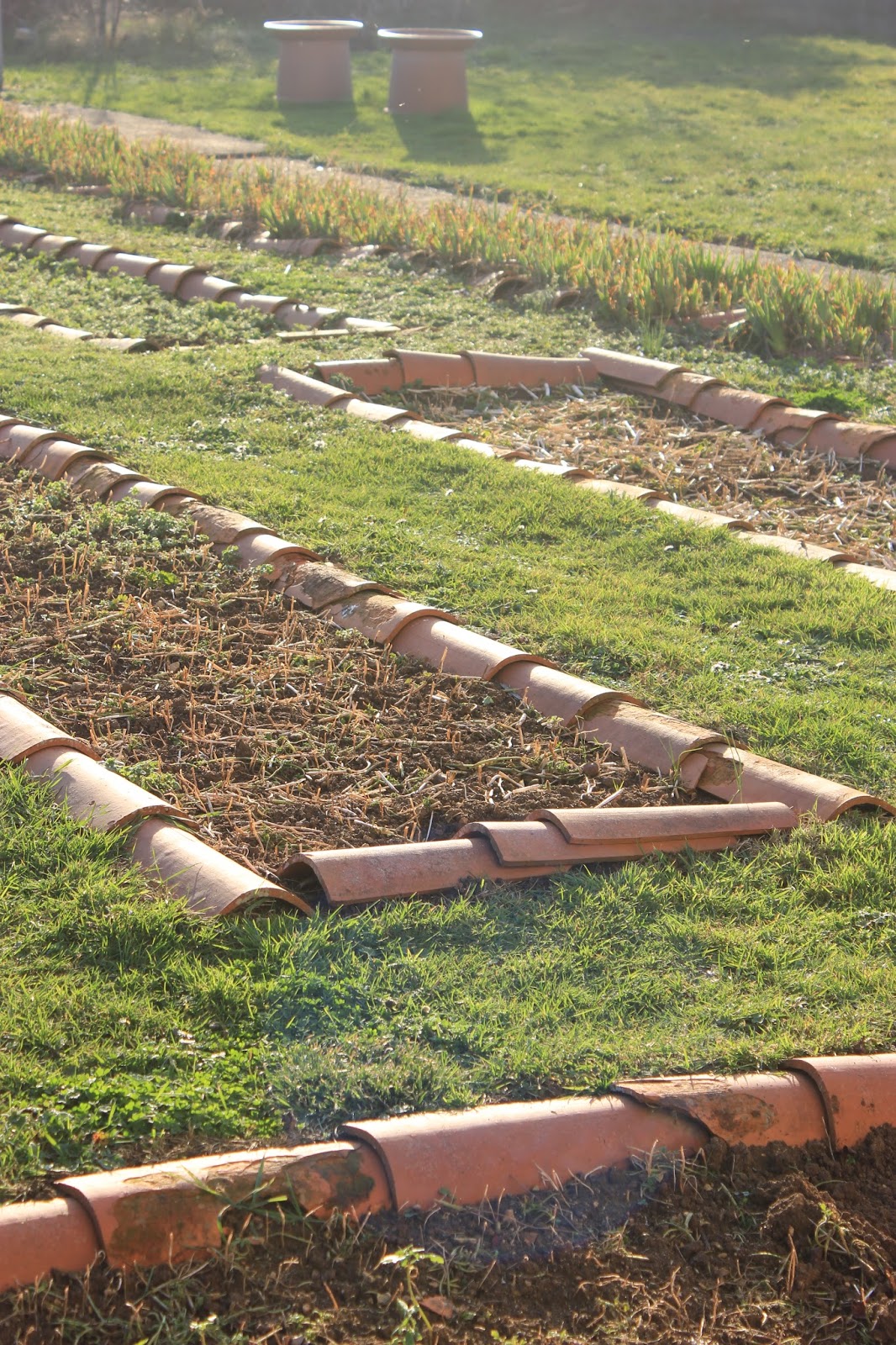
Most of the winter mustard crop has been chopped down and incorporated into the soil. Any chunky bits will be raked off and reserved as mulch or put on the compost.


The paths between the veggie beds have gotten their first cut of the season via the string trimmer.


The lawn is sparkling with small flowers as sunlight bounces off sweet violets, English daisies, and forget-me-nots.

A single blue forget-me-not easing between two, burgundy, wandering tips of stonecrop

As the heather fades, the daffodils pop.

Looking towards the garden from the sous-sol's door

When the garden is more barren than not, seasonal object constancy is challenged as remembering the inevitable transformation of brave but sparse colour to lush and enveloping seems to have become rusty. This photo from a past May gives a shine to those memories.

Looking towards the sous-sol's door from the garden

À la prochaine!

RELATED POSTS

How to divide Irises


Wednesday, 8 February 2017

Simple Pleasures

When a wintry weekend afternoon reveals gloom not only on the news, but also in the damp and forlorn garden, the way to boost my fast-deflating spirits via a warming snack is as uncomplicated as baking a potato, the largest one in our cellier, roasted till its skin is crusty, slashed with a double cross so its fluffy insides can be puffed-out to be saturated with butter, crème fraîche, and chives, making that steaming, fragrant bundle look like it is puckering for a kiss. Though I am tempted to return the gesture, I am bien élevé enough to use a fork.


Preheat oven to 230 degrees C/450 degrees F. The chosen potato measures about 13 cm/5 inches long by about 7 cm/3 inches wide and is a floury type (low-moisture content) well-suited for baking. If you can't find baking potatoes then go with all-purpose. Scrub well and dry.


To let out steam as the potato bakes, prior to oven-time, pierce it all over with the tines of a fork. For a potato this size, ten stabs will be in order.


Roast for 50 to 60 minutes right on the centre rack till the skin is crackly and flesh is tender which can be tested by inserting a sharp knife in the centre. Place the baked beauty on a paper towel, potholder, or tea towel. Slash through the skin lengthwise and then make two perpendiculars near the ends of the initial cut.


Protecting your hands with the tea towel, press on both ends simultaneously towards the centre.


Fresh chives of course are the highest quality choice, but the second best are freeze-dried ones. They rehydrate quickly, retaining flavour and texture closer to the fresh version. You may have to hunt a bit for these as the less-expensive, air-dried herbs are way more common.


Put a noix (knob) of butter and a heaping teaspoon of crème fraîche (or sour cream) along with several mega-pinches of chives. A good sprinkling of salt is the final touch.


Carefully mash and mix with a fork, till all the ingredients are nicely distributed.


As you eat, don't be shy. Add more butter, crème fraîche, and chives.


And what's waiting at the bottom? The glorious skin!

A large potato with skin has about 1000 mg of potassium! 

À la prochaine!

RELATED LINKS

Health benefits, food sources, and recommended daily allowance of potassium


Thursday, 2 February 2017

Savoury Parmesan Green Bean Potato Pie

At this time of the year, I make a thorough investigation of our freezer, checking to see what produce remains from the fall harvest. Ah, lots of green beans! Rachel Roddy, a Rome-based food writer and cookbook author, offers an enticing collection of homey, delicious, inexpensive, and uncomplicated recipes. The sundry produce from our potager found on the larder shelves/potted-herb window sill and in the root cellar/freezer often wind up in her recipes. Her inspirational approach to get you cooking includes wonderful stories of people enjoying precious moments and her encouraging to relish the process of cooking while experimenting to see what suits your individual taste which is exactly what I have done with this pie as I have included lemon zest (The Calm One serendipitously brought home a batch of untreated lemons), dried tomatoes from our garden, and parsley (the only herb on the sill). Think of what you have on hand to make this accommodating dish.

A hearty & easy-to-make breadcrumb crust presents a contrasting crunch

Ingredients
makes 6 ample servings

  • Potatoes, boiled in their skins, peeled, riced, 500g/18 dry oz
  • Green beans, cooked, roughly chopped, 450g/16 dry oz
  • Parmesan, freshly grated, 100g/3.5 dry oz
  • Eggs, 3
  • Tomatoes, sun-dried, rehydrated, finely chopped, 1 T
  • Parsley, flat-leaf, fresh, minced, 1 tsp and extra for garnishing
  • Lemon zest, finely grated from an untreated lemon (reserve some strips for garnishing), 1 tsp
  • Olive oil
  • Breadcrumbs, fine, about 16 T
  • Salt and freshly ground pepper

Preheat oven to 177 degrees C/350 degrees F. Get cracking those eggs!


Lightly whisk eggs in a bowl big enough to hold the finished mixture.


Add the potatoes, chopped beans, lemon zest, sun-dried tomatoes, Parmesan, parsley. Mix well and season to taste with salt and freshly ground black pepper.


Lightly oil the sides and bottom of the pan (20 cm/8 inch round) and remember to grease where the sides and bottom meet.

Want to make your own breadcrumbs? Instructions are in this post

Spoon the mixture into the crumbed pan. Level and press down the filling with the back of a spoon/spatula.


Top with a thickish layer of crumbs and sprinkle well with olive oil. I sprinkled less than well, using just a tablespoon of oil. Next time I will be more generous with the sprinkling since it will not only add richness and flavour, but also will tame the crumbly nature of a breadcrumb crust. Another method would be to mix oil and crumbs in a bowl till well-moistened before placing them onto the filling.


Bake 50-60 minutes till lightly puffed and browned. Let cool for twenty minutes. Garnish with lemon peel and parsley. Either slice right in the pan or if the pan has a removable bottom, loosen edges of the pie with a narrow, flexible spatula/knife and gingerly push up from the bottom with a hand, lifting it out on its own platter. An astuce: aim for upwardly slanting a part of the pan's bottom onto the rim which will serve as support over which the entire pie can slide onto the other hand, palm-side-up of course.


This pie with its cheesy, eggy taste and creaminess (thanks to the potatoes) is both satisfying and comforting. Serve warm or at room temperature.


Having enjoyed the tasty simplicity of this dish so much, I am devising a list of ingredients for another one: chopped, roasted sweet red pepper (there's an ample amount from the fall harvest in the freezer) instead of the green beans along with swapping the herb fennel (now rising from wintry muck) for the parsley, and adding garlic. How even nicer it would be made with potatoes from our potager!


À la prochaine!

RELATED POSTS (other Rachel Roddy recipes that I have made)

Roasted Sweet Red Peppers and Tomatoes
Italian Pasta and Beans
Pasta and Potatoes Minestra