Tuesday, 17 June 2014

Hot Sandwich Wraps...and the twilight garden

If the Borscht Dumpling God decrees there will be a surplus of that nice soft dough made just with milk, flour, and salt, I'll stretch my culinary noodle so to speak and make some fresh pappardelleHowever, one early evening saw my rolling that pliable mass into a circle which demurely asked to be left whole. Inspired by its shape, round and round I went in the kitchen gathering ingredients -- a few fresh sage leaves there, veggie oil here, and some eggs way over there. A mental image of a pan-fried sandwich wrap stuffed with speckled-with-sage scrambled eggs gradually came into focus.


For one 20 cm diameter wrap, thinly roll out some dough (mix 600 grams of plain, white flour, 325 ml of milk, and 1/2 tsp salt together and then knead about five to eight minutes until smooth which makes five pieces the size of baseballs, so a lot but they can be frozen or kept in the fridge for about a week) the size of a golf ball into a circle more or less -- any irregularities will not be noticed after it puffs up in hot oil.


Cover the bottom of a heavy skillet with an 1/8 inch (.3 cm) of oil and heat over moderate flame for a minute or two. Carefully ease the dough into the pan.


Let it fry for a couple of minutes or until it is covered with air bubbles and is nicely brown, and then flip it over. Reserve warm.


Rinse and chop a few fresh sage leaves. Pour off the excess oil in the skillet. Scramble some eggs beaten with the sage in what will still be a well oiled pan.

The Calm One replaced our spatula with one of my favorite colour, royal blue!

Blot it if so desired, put on a plate and arrange the eggs well inside one half of the wrap. Pick up the edge closest to the eggs and neatly tuck them within the first roll which needs to be nicely packed. Continue tightly rolling to the other side.


Cut into four pieces, their warmth comforted, their taste pleased, and their substance fulfilled.

As I gobbled down these using my hands, that fork is just for show!

Well fed, I returned to the garden to finish up the day's work and to take some photos in the twilight because such a setting shows a different side -- flower details are not washed out by abundant sunshine while the darker background makes their delicate outline be seen more clearly. The abelia, beloved by bees, is covered with tiny, sparkling flowers.

Their red sepals are pretty too!

The late season potato variety, desiree, which I had sowed just a mere two weeks ago, is flourishing in that lusty way happy plants have.


The potted bougainvillea is putting out its first flush of fabulous, pink bracts. Their actual flowers are tiny and inconspicuous.


These lilies are planted close to the front pathway which makes it easy to get a whiff of their heady fragrance when we are coming and going.


The perennial day lilies took several seasons after their planting to feel at home. Though a flower lasts just a day, they put out an abundance of them successively.


The shasta daisies are wonderful perennials to have in the garden; they are beautiful, generous, and flower all the way into autumn.


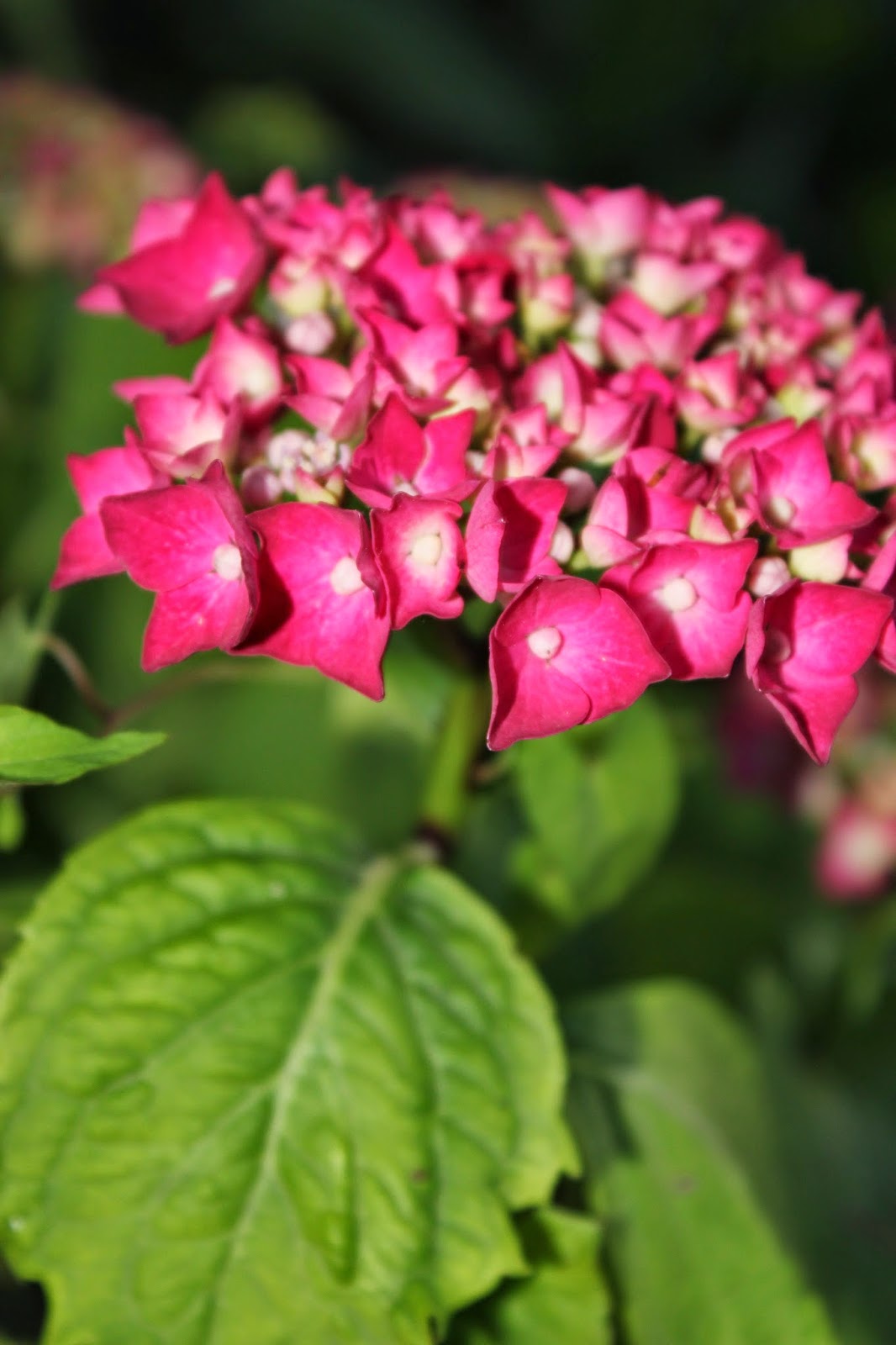
Hydrangeas, like peonies, usually don't do well in our long, dry, hot season, but I appreciate whatever they do.

Think of tucking a few perennial herbs here and there because they add so much to both the kitchen and garden. When picked fresh they perk up pasta, eggs, soups, stews, spreads, quick and yeast bread batters in the way only they can. Additionally they are great for garnishing. Outdoors they give both unusual foliage and flowers. Fennel which is now about six feet tall and whose feathery foliage is past its prime is putting out flower caps. By autumn they will be transformed into seed clusters. The young green seed tastes like dill seed while the mature grey-brown ones resemble caraway.


David Austin's Falstaff is revving up for another bunch of blooms.

That purple glow in the left background is lavender

I tried to photograph a murmuration of starlings who were flying to a couple of spruce trees for roosting, but instead I accidentally got this appealing shot of the mellow setting sun -- the sky in the upper half is a warm, pink-tinged gray while the lower half is tinted a cool blue-gray.


À la prochaine!

Tuesday, 10 June 2014

Pasta & Fresh Peas...and already buttered toast

Growing sweet green peas is always a challenge chez nous since we often do not have a long enough bout of cool weather for them to do really well. The ones planted this past February have produced a middling harvest, but the lack of abundance is more than compensated by the remarkable taste of what I consider to be more akin to green candy than a lowly veggie especially when it's eaten raw right out of the pod. Super fresh peas only need about a two/three minute dunk in simmering water. They are exceptional in form and substance when they come out of their beauty bath. If cooked longer, they will lose the very vibrancy which makes eating them so special.


Choose your pasta and put in boiling water.  Don't forget to add a handful or so of shelled, rinsed, fresh peas about a few minutes before the pasta is done.

With a few minutes more of cooking time, pasta and the just added peas will both be done

Saute some minced garlic and thyme in olive oil. Add several tablespoons of pasta cooking water. 


Since last season's garlic harvest is depleted, I have started pulling the present planting and using the bulbs without any curing. Their pleasing taste is closer to green onion than garlic.

By mid-July, they will have formed a cluster of papery, separate cloves instead of the onion-like bulb at present

Toss the slightly underdone, drained pasta into the skillet and cook the sauce down until all is coated well. Grind some black pepper over it and salt to taste.


Grated Parmesan could be sprinkled on but I am usually scoffing this simple but excellent dish before I even realize that there is cheese in the fridge. If there is some fleur de sel on the table, I do manage to dust my serving with that.

Some may say, too many peas! I say, not enough!

As with green beans, it is necessary to keeping picking pea pods every other day to encourage a bigger harvest. During the several weeks of harvesting, I have no problem fitting them into our menu.

Peas, potatoes (also from our potager) au gratin, and pot roast of lamb

Machines purpose built for just toasting bread are usually hard to keep crumb free while the bread needs not to be too thick or too thin. By the time it comes to the table, it is no longer hot enough to melt butter whose application then grates the toast causing an avalanche of crumbs. I do bake slathered-with-garlic-and-olive-oil whole slices of sourdough rye for topping our French Onion Soup and saute bread in bacon fat. However, sometimes you just want hot, buttered toast.

Using room-temperature butter, apply a thin film to both sides of the slice. Place in a heavy-bottomed skillet and grill at moderate heat for a couple of minutes or until it is toasted to your preference. Flip over and repeat.


This pan-grilled bread has a soft inside and a crunchy crust. And it is already buttered!


We like accompanying this kind of 'toast' with homemade soups. Flavoured versions (herbs, cayenne, cinnamon, vanilla extract, etc.) can be substituted, but usually I go plain because French butter is fabulous by itself. Of course, instead of the yellow yummy stuff, any tasty oil can be used, like olive or walnut or sesame.

Carrot soup and its best friend, grilled sourdough rye

English lavender, which bees adore, is in full bloom.

Two strawberry beds in front; rhubarb, raspberries & a corner of a tomato bed in the background

That's a bee, right? I don't want to be waxing poetic over hornets!

Oh yes, the early summer garden is humming along. Foreground: fennel, sage, tub of blueberries; mid-ground: staked tomatoes, two potato beds -- the yellowed foliage is a soon-to-be-harvested midseason variety; background: laurel nursery bed, irises, grapes, blackberries, red currants, and small peach tree. Incidentally, that's a duvet cover in the upper right and not some immense, tropical flowering plant intent on taking over the garden.


The early variety of the two potted -- to provide the acid soil they need as the pH of our soil is neutral -- blueberry plants already are putting out a few plump, sweet berries.


À la prochaine!

RELATED POSTS
How to make fresh green pea pesto

RELATED LINKS
Giulietta Carrelli, her courageous toast 'palace', and how the artisan toast craze started

Tuesday, 3 June 2014

La Crique Ardéchoise...and the first potato harvest of the season

The potato pancakes as presented by various Ukrainian restaurants located close to the New York City apartment in which I lived when a young working lass were not memorable. The ones I made in my own compact kitchen at that time were not much more noteworthy, though the homemade apple sauce adorning them was fantastic. I put mountains of this 'condiment' on my serving similar to the way the little girl who I once babysat would not only smother flapjacks with maple syrup, but also would tip her plate and slurp down the syrup while asking for seconds, that is, just of the sweet, sticky liquid. But potato pancakes need not be so embarrassed as to cover their face; they can be crusty, delicious, and lovely while leaving the sour cream/apple sauce facial masque for their grey, soggy counterparts.


When living in Grenoble, we were able easily to visit the departement of Ardeche which was about an hour's drive away. Though we did not partake in its well known, dinner-plate-sized, speckled-with-parsley-and-garlic potato galette while there, I will never forget what a beautiful area it is -- a breathtaking, gorgeous landscape combination of the British Peak District and the foothills of the Alps.

In our potager, Dolwen, a primeur potato, has just started to be harvested. Uncommon for an early variety, its texture is closer to an all-purpose potato, rather than the usual firmer/moisture-rich one best used for only salads and steaming.

One of the seventy-five potato plants I managed to get in the ground this season!

Therefore it can be made into soup, au gratin, smashed or mashed potatoes, salad, not to mention steaming the smallest in their pretty jackets, then drenching them with butter, and finally sprinkling the dainty ovals with fresh, minced flat-leaf parsley and fleur de sel.

The smaller ones are reserved for steaming

If dug right from the ground, make sure you give them a good scrubbing. For one generous serving or for two smaller ones, gather two large all-purpose potatoes, several small parsley sprigs (remember to save one for garnishing), one garlic clove, one tablespoon of extra-virgin olive oil, one tablespoon of butter, black pepper mill, and salt.

All three ingredients are from our potager!

Using the proper hand/electric tool, finely grate the peeled potatoes onto a plate.

The world's greatest hand grater which stores various inserts in itself.

Squeeze out as much liquid as possible into a bowl. I use my well washed hands to do this, but the grated potatoes can be pressed against a wire-mesh sieve or wrung out in a clean tea towel. They will be much dryer, with more separate strands, and a bit fluffy. Put them in a medium-sized mixing bowl.

They will look more like a pile of grated cheese when dry enough.

Let the potato liquid sit a few minutes until it is mostly clear. Finely mince the garlic and parsley.

This is not a beaten egg!

Carefully pour off the watery top layer into the sink, reserving the white, thick starch at the bottom which will take the place of an egg for a binding ingredient.

Any grated potato that made its way into the liquid will settle to the bottom

Add the starch along with the minced parsley, garlic, salt, and freshly ground black pepper to the grated potatoes. Mix well with a wooden spoon.


Heat the oil and butter over medium-high heat in a medium-sized heavy skillet for a few minutes until very hot. The bottom should be covered lightly with the fat mixture. Using enough oil (to raise the smoking point)/butter (for taste!) is essential for developing a delectable crust.


Put the potato mixture into the pan, flattening out the pile into a pancake the size of the fry pan with the use of a large wooden spoon or a spatula.  This method of using all available skillet real estate when making one large pancake is a clever approach. Over medium-low heat, cook for about twelve minutes. Be sure to refrain from covering the pan during cooking as it will be more steamed than sauteed.

The grated potato will begin to get opaque and 'melt'

From time to time, flatten and even it out with a spatula while neatening the edges.


Check occasionally to see how the under crust is developing, adding more oil/butter if deemed necessary for pronounced crisping.


At this stage it likely will be too soft and flexible to flip over using most spatulas. Take the skillet from the heat, and while firmly holding in place the right-sized plate over it, turn the apparatus upside down. Voilà! The crique should now be on the plate, browned side up. If it has ungratefully folded itself during this procedure, try your best to unfold it as gently as possible. Put another plate of the same size on top and flip again, uncooked side is now up.


Put the skillet over the plate and flip this apparatus upside down. The crique, unbrowned side downshould now be in the pan! Cook for another twelve minutes.


Loosen with a spatula and slide the galette onto an attractive plate. Cut into fours -- I used a pizza cutter to do this. Since I forgot to reserve some parsley for garnish, some fresh dill graciously subbed for it.


Crunchy and succulent with each bite, a savoury crique is traditionally served with a salad or as a side for meat. If a heftier pancake is desired with a greater proportion of succulence to crunch, then use a smaller skillet or increase the amount of potato along with the parsley and garlic. More time will be required. But don't forget to nurture the crust regardless.


À la prochaine!

Tuesday, 27 May 2014

Linguine with Olive Oil, Green Onions, Fresh Dill & Tuna...and cherries galore

Thank goodness for canned tuna! Both The Calm One and I have been fighting nasty colds. Our valiant battle has put us in a state of suspended animation though still capable of being hungry. That's when the shiny, little tin of tasty fish, gleaming its presence from a cupboard which is looking less stocked as time goes on and the crumpled Kleenex pile up, said in that influential tone tuna is known to have, choose ME to put in your pasta! 


This past February, I planted onion sets close together, one or two inches apart, so I could harvest scallions (green/spring onions) starting around April which I have being doing with a marked air of delight. Pulling them this young not only gives us some greens but also allows the others to mature into fat onions. Happily a few dill seedlings volunteered from last year's planting, so some of their tiny, feathery fronds were also picked. While the linguine is cooking, lightly saute chopped scallions and fresh dill in some olive oil for a minute.


Add the drained tuna and some of the pasta cooking water. Break up the fish with a wooden spoon. Simmer for a minute or two, while stirring here and there.


Toss in the slightly underdone pasta, letting it finish cooking while the sauce thickens, about a minute or two.


Serve immediately and season to taste with salt and freshly ground black pepper. Nourishing and tasty fare for sure, but also its fresh greenness cheered this mostly house-bound gardener, reminding me of the bounty waiting outdoors.


Le ceresier chez Monsieur and Madame M is gloriously burdened with so much fruit that generous donations of its plenty have been made to nearby households, including chez nous.

Make a wish for a vie en rose!

Our capacious yellowware batter bowl was perfect to accommodate the juicy, sweet abundance.


In addition, The Calm One and I were recently invited to have our way with this laden-down tree.

Left side of bowl!

On the allotted day, The Calm One ventured forth on his own as I was still cloué au lit (nailed to the bed). So far what he has picked we are enjoying just as is, but who knows, a claufoutis may be in our future.

Right side of bowl!

My cold being the tenacious kind that occurs in the spring has allowed me the energy to get just the peppers transplanted. The melons, cucumbers, winter squash, among the remaining re-potted seedlings, are suffering the most despite being in larger containers. I apologise each time I hobble onto the patio, saying in a soothing voice, my little ones, you will soon spread your roots.

The garden about a week ago when it still had a full-time gardener!

À la prochaine!